
Complete Guide to the 7 Chakras Symbols: Meaning, Energy & Healing Explained | Gurukul Yogashala | Best Yoga Teacher Training School in Rishikesh

Complete Guide to the 7 Chakras Symbols: Meaning, Energy & Healing Explained

Have you ever felt stuck – physically, emotionally, or mentally – but have struggled to explain why? Maybe you went to a yoga class and the instructor mentioned “the chakras,” and you nodded your head along but were secretly asking yourself, “What the heck are the chakras?!”

You’re not by yourself if that’s how you feel. The chakras are probably the most discussed reference in yoga and wellness, yet they also continue to be one of the most misunderstood ideas out there. However, once you truly comprehend the chakras – meaning you get what they are and what they represent – they’ll no longer appear to be an abstract notion but will instead become one that is uniquely yours.

The purpose of this guide is to take you step-by-step through each of the seven chakra symbols, explain to you what they represent, how they affect your energy system, and ultimately, show you ways you can incorporate the chakras into your everyday life.

What Are Chakras?

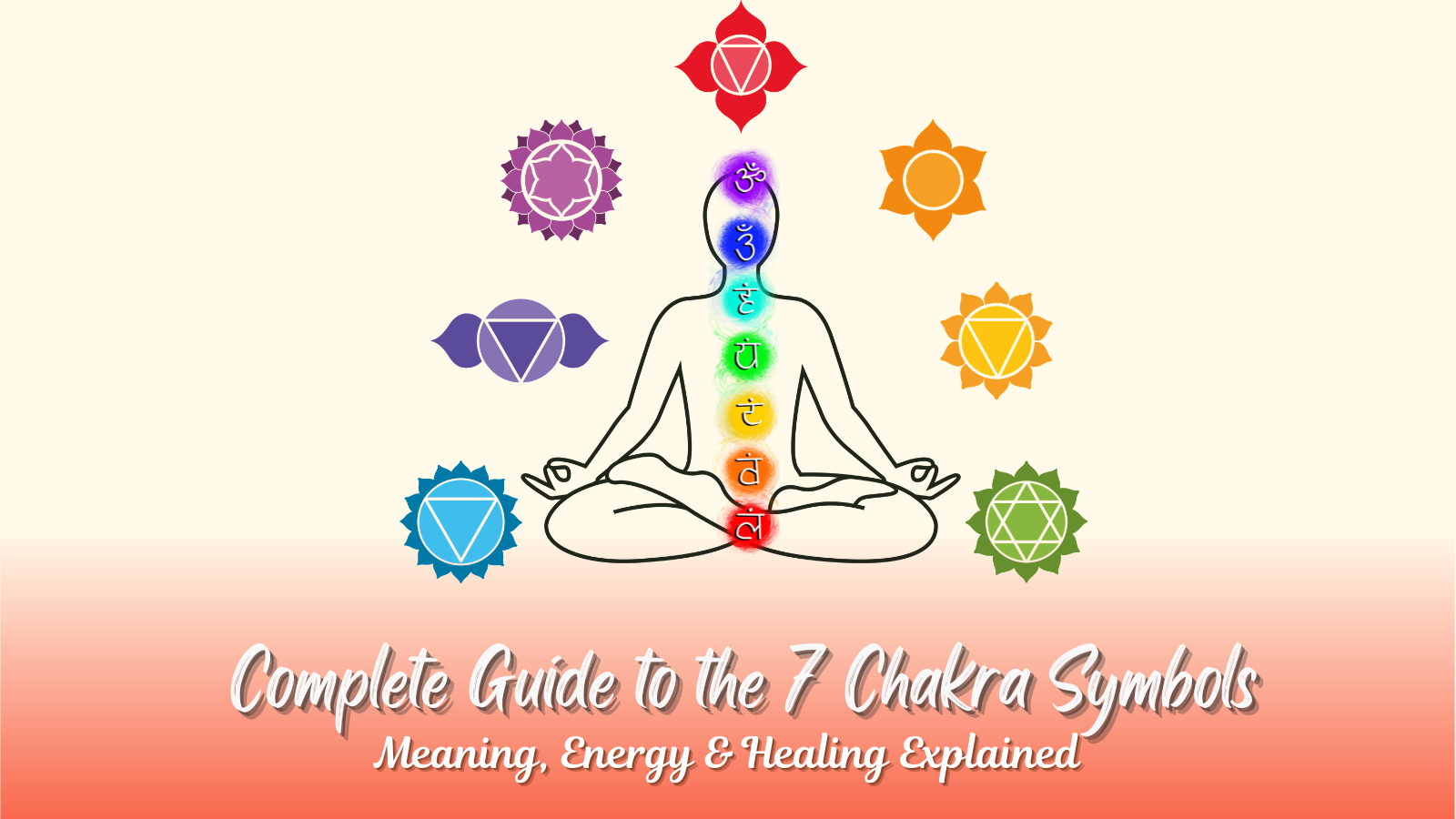
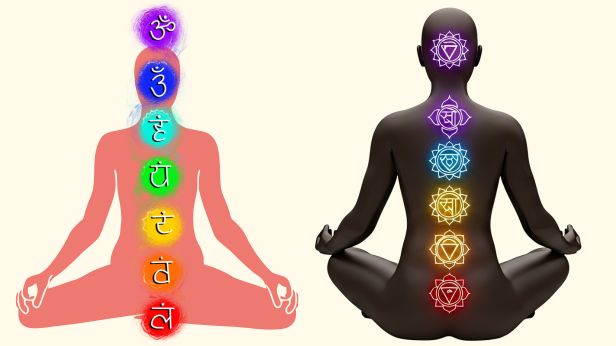
The term “chakra” is derived from the word “chakra” in the ancient language of Sanskrit, meaning “wheel” or “cycle.” Chakras are the rotating centers or vortices of power (or energy) along the axis of the body – from the base of the spinal column (root) to the top of the head (crown). The chakra system contains 7 major energy centers with their own corresponding emotional, physical, and sensory properties.

While most people think of chakras as a new concept that has only recently emerged within our modern society, in fact, the chakra system has been utilized in some form for over 3,000 years as part of India’s ancient spiritual philosophies (the Vedas, the Upanishads). 

When your energies (chakras) are open and balanced, your life force (qi, prana, ether, etc.) flows smoothly through both your physical and subtle bodies; you will experience health and happiness as a result of having a balanced system of energy flowing through both your physical body and your subtle body. Conversely, if one or more of your chakras is either blocked or overly active, there will be a disruption in the flow of energy throughout your body (i.e. you may feel anxious, suffer from persistent physical pain, have difficulties in relationships, lack self-confidence, or feel disconnected from who you are).

Let’s connect!

1. Muladhara – The Root Chakra

Location: Base of the spine 

Color: Red 

Symbol: A four-petalled lotus with a square and downward-pointing triangle at the center

The root chakras is your foundation and represents your sense of safety, stability, belonging, and basic needs for survival (food, shelter, financial security, etc.), and the assurance that you have the right to exist and the space to take up in this world.

When you are in balance, you will feel grounded, secure, and calm (even in times of uncertainty). When you are blocked, fear, anxiety, and an overall feeling of instability will most likely prevail. 

Signs of imbalance: chronic anxiety, financial issues, pain in the lower back, and feeling disconnected from the body. 

How to activate it: through foot contact with the earth, grounding in yoga positions, using the seed mantra LAM, and using a red stick are good ways to balance your root chakra. 

2. Svadhisthana – The Sacral Chakra

Location: Lower abdomen, just below the navel 

Color: Orange 

Symbol: A six-petalled lotus with a crescent moon inside

This chakra is responsible for your creativity, pleasure, emotions and relationships. It governs the way in which you connect to others, experience joy, and relate to your own feelings and desires.

When the sacral chakra is open and balanced, your life feels ‘juicy;’ you create freely, connect easily with others and emotionally flow. Conversely, when it’s blocked you may feel emotionally numb, creatively stuck or experience mood swings between extreme ends of the emotional spectrum.

Signs of imbalance: low libido; creative blocks; emotional rigidity; tightness in your hips; or feeling guilty about enjoying pleasure. 

How to activate it: doing hip-opening poses like Baddha Konasana; dancing; expressing your creativity; using water; chanting the seed mantra for the sacral chakra which is “VAM”; and surrounding yourself with orange. 

3. Manipura – The Solar Plexus Chakra

Location: Upper abdomen, stomach area 

Color: Yellow 

Symbol: A ten-petalled lotus with a downward-pointing triangle

Manipura means ‘place for storing jewelry’. It is where you find your personal strength (will), self-belief (confidence), discipline, and sense of self. It is the heat in your belly (inner fire).

When it is in balance, you can pursue your goals with clarity and confidence. However, if it is in a depleted state, you may feel powerless, overly controlled by others or become domineering and controlling. 

Signs of imbalance: low self-esteem, digestive problems, excessive desire to please others or controlling/aggressive behaviours. 

How to activate it: Trying yoga poses focusing on strengthening your core, complete and active Kapalabhati breathing, chanting ‘RAM’ as a seed mantra, eating foods that are yellow (e.g., bananas, turmeric), and getting outside in natural sunlight.

4. Anahata – The Heart Chakra

Location: Center of the chest 

Color: Green 

Symbol: A twelve-petalled lotus with two overlapping triangles forming a six-pointed star

The term “Anahata” means “unstruck sound,” which denotes the creation of sound before all things have been created.

The Heart Chakra is the gateway between the three lower: 1) Base, 2) Sacral; and 3) Solar Plexus chakras and the three upper: 4) Throat; 5) Third Eye; and 6) Crown chakras. When the Heart Chakra functions at its highest potential, you are able to love fully (self and others) without becoming lost in the process. When it becomes blocked, it may feel like a wall around the chest, an inability to trust, or anguish that will not move. 

Signs of imbalance: feeling lonely; having difficulty forgiving; becoming co-dependent on others for love; tightness in the chest and shallow breathing. 

How to activate it: performing back-starting/heart-opening poses, such as Ustrasana and Bhujangasana, meditating using “loving-kindness” techniques, using YAM as a seed sound; and spending time outdoors in places that are rich in green plants and trees 

5. Vishuddha – The Throat Chakra

Location: Throat 

Color: Blue 

Symbol: A sixteen-petalled lotus with a downward-pointing triangle and circle inside

The concept of Vishuddha means “purity,” representing the expression of one’s truthful communication with self and others while also being able to listen fully during discussions or conversations.

When your throat chakra is open, you have the ability to express yourself with genuine words and emotions. You are capable of following through with your convictions, saying “yes” to what you truly want, and remaining silent when you have no desire to speak. 

Signs of imbalance: difficulty speaking your truth, feeling fear of being judged, and talking too much or too little. 

How to activate it: you can chant, journal, perform Jalandhara Bandha (throat lock), use the seed mantra “HAM,” or talk openly and truthfully.

6. Ajna – The Third Eye Chakra

Location: Between the eyebrows 

Color: Indigo 

Symbol: A two-petalled lotus with an inverted triangle and the Om symbol inside

This chakra represents the concept of “command” and “perception.” In addition to being associated with intuition, inner wisdom, clarity, and insight, this is also your ability to understand those things that are beyond the capability of the logical mind; that still small voice within that you often refer to as intuition and usually leads you to a correct conclusion.

When balanced and functioning correctly, you are able to trust your intuition, see things as they really are, and feel confident in your own decisions based on solid intuition. When you are in a state of imbalance, typically you may find yourself confused, overthinking everything, and unable to trust what your inner voice is telling you.

Signs of imbalance: headaches, indecision, inability to focus, ignoring gut feelings and/or relying too heavily on the opinions of other people.

How to activate it: engage in trataka (candle gazing), practice silent meditation, work with yoga nidra, use the seed sound mantra (OM), and limit their use of electronic devices to create space for yourself mentally. 

7. Sahasrara – The Crown Chakra

Location: Top of the head 

Color: Violet or white 

Symbol: A thousand-petalled lotus

The Sahasrara Chakra represents pure consciousness, spiritual connection, and a sense of being part of something larger than yourself. While it is not religion-based, it is the feeling that life is meaningful and that you are not separate from it.

When your Sahasrara is open, it provides you with a sense of peace that does not rely on external conditions. When your Sahasrara is blocked, you may feel that there is no meaning in your life, that you are disconnected, or that your life is mechanical. 

Signs of imbalance: Spiritual disconnection, a cynical outlook on life, feeling empty all the time, or having an excessive attachment to material possessions. 

How to activate it: Deep meditation, silence, spending time outdoors, using breathwork techniques, and practicing surrender – letting go of control over everything 
Complete Guide to the 7 Chakras Symbols: Meaning, Energy & Healing Explained | Gurukul Yogashala | Best Yoga Teacher Training School in Rishikesh

Going Deeper – Learning Chakras Through Yoga Teacher Training

Gaining information about chakras is nice, but in reality, real knowledge of chakras, experiencing them yourself, teaching them to others, involves a different level of working with the information.

This is precisely the kind of knowledge that can be gained during a residential yoga teacher training in Rishikesh. Because not only is it taught through reading and studying, but also by way of experience through the daily yoga and meditation practice and the energy of one of the most spiritual cities in the world.

Chakra philosophy, pranayama and meditation are integrated into all levels of training at the Gurukul Yogashala. The  200 hour yoga teacher training in Rishikesh gives you the complete system of chakras along with asana, anatomy and yogic philosophy – promoting a well-rounded and strong grounding. For those interested in delving further into energy anatomy, subtle body work and the all-encompassing yogic tradition the 200 hour yoga teacher training in Rishikesh leads to the 300 hour yoga teacher training in Rishikesh.

If you are destined to walk the entire professional path with all the trimmings and trappings from the get-go, the 500 hour yoga teacher training in Rishikesh condenses everything -from root to crown- in one all-encompassing, life-altering experience.

And if you have ever been in a yoga class and felt something change in your chest during a heart-opening pose and thought, What just happened – then the Yoga Teacher Training in Rishikesh is for you.

Final Thoughts

You do not need to memorize the seven chakras as they are not merely concepts but a living, breathing representation of your inner world. All your emotions and physical sensations, the recurring patterns of your relationships, and all other aspects of your life have a spot on the map that the chakras represent, so they are a roadmap of your inner world.

To work with the chakra symbols is not to become a spiritual being out in the ether but to be more honest about yourself, more aware, and to embody your wholeness. You will find the chakra that you are experiencing the most resonance with and sit in front of its symbol, breathe in the area where it resides within you, and observe what you notice.

The journey inward is the most significant journey that one will take, and it starts at the place you are now.

Frequently Asked Questions

1. What are the 7 chakra symbols and what do they represent? 

The seven chakras are Muladhara, Svadhisthana, Manipura, Anahata, Vishuddha, Ajna, and Sahasrara. Each chakra has a name, a symbol, a color, a location on the body, and an area of life that the chakra regulates (from basic survival and safety to spiritual consciousness). 

2. What is the meaning of each chakra symbol? 

There are seven chakra symbols, which are all lotus blossoms with a different number of petals; each symbol also has different geometry that corresponds to the vibrational frequency of the energy center it represents, and each chakra symbol has letters written in Sanskrit that represent the vibrational frequency of the energy center. For example, the root chakra symbol (Muladhara) has the square shape because it corresponds to the earth and/or the stability associated with that location; whereas, the heart chakra symbol (Anahata) has the six-pointed star shape because it corresponds to the union between earth and heaven. 

3. How do chakra symbols affect energy and healing? 

Chakra symbols are used as visual tools for meditation and intention; focusing on a specific chakra symbol helps you draw awareness towards that energy center, thereby activating it, and supporting the clear removal of blockages that may be present. Once you focus on that energy center for a long time period (with breathwork and movement) it creates measurable changes in both your physical and emotional feelings. 

4. How can I activate or balance my chakras? 

You can activate the energy in your chakras through yoga asana, pranayama, meditation, chanting seed mantras, visualization, sound healing, and nature. Each energy center has a corresponding color, sound, food and other practices, so chakra work is very personal and can be tailored to the individual. 

5. What are the signs of blocked chakras? 

Each chakra has different symptoms of being blocked. Common symptoms are chronic anxiety or fear (root), creative block (sacral), low self-confidence (solar plexus), unable to express love or forgive (heart), trouble communicating the truth (throat), over-analysis or numb to your intuition (third eye) and disconnected from your spiritual self or lack of spirit (crown). 

6. Why are chakra symbols used in meditation? 

Chakra symbols act as yantras (a form of concentration tool). You can focus on them while meditating in order to help still the mind that is scattered and create an inward flow of the energy to the different centres of the body using higher frequencies than those found in the outer world. By using visual symbols of an energetic nature the mind has something tangible to focus on while practicing. 

7. What colors are associated with each chakra symbol? 

Root – Red

Sacral – Orange

Solar Plexus – Yellow

Heart – Green

Throat – Blue

Third Eye – Indigo

Crown – Violet or White

These colours correlate to the vibrational frequencies associated with each of the chakras and can be used to create a visualisation, wear as clothing, use crystals or incorporate as part of your environment to achieve balance. 

8. Can chakra symbols really help with emotional healing? 

Yes – if they are used on a consistent basis and with intention. Working through your chakras provides a framework for understanding the emotional patterns that reside in your body, and how to address them. The combination of chakra work with yoga and meditation is an extremely powerful method of processing the feelings of grief, anxiety, anger, and disconnection in a grounded and embodied manner. 

9. How do beginners start working with chakra symbols? 

The best way to start is to keep it simple. Gather the information about the location and color of all of your chakras, and then select one chakra with which you feel connected to your current emotional state. Sit still, put your hand on the area of the body where that chakra resides, breathe deeply and visualize the color and symbol for that chakra. Doing this just five times a week for five minutes will create awareness and change the energy in a particular area of your body over time. 
How to Become a Certified Yoga Teacher - Instructor | Gurukul Yogashala | Best Yoga Teacher Training School in Rishikesh

How to Become a Certified Yoga Teacher: A Complete Guide

If you love yoga, and you have been doing it for some time now; you have probably had the same thought over and over again…what if I could teach yoga? Well, this thought is very valid.

Becoming a certified yoga instructor offers many rewards personally, such as deepening your practice, changing how you look at/feel about yourself and learning to help others through yoga (by teaching them). These things make becoming a Certified Yoga Instructor very rewarding.

So now what? How do you get started? What does it mean to be certified? What type of certification is right for me? You can find all the answers you need in this guide, which is designed to be straightforward and helpful.

Why Yoga Teacher Certification Matters

First, let’s talk about the significance of being a certified yoga teacher.

The roots of yoga go back thousands of years, but in today’s world, when a student enters the yoga studio, they have the right to know that their instructor has completed appropriate training. Health and fitness certifications provide an established standard to the student, the studio, and the employer, giving everyone the confidence that the teacher is knowledgeable about the subject matter.

A fact worth considering is that there are over 100,000 yoga teachers around the world who are presently registered with Yoga Alliance, and the demand for certified yoga instructors continues to grow every year. The global yoga industry is estimated to be worth an estimated $80 billion and continues to grow. Becoming certified will not only create a stronger foundation for your practice, but it will also create long-term, legitimate career opportunities.

Step 1 – Build Your Personal Practice First

You need to have solid personal practice before you start teaching. While this may seem obvious, many teachers overlook this fact.

Building up a substantial personal practice is essential to having awareness in your body, being disciplined and having an actual understanding of what it feels like to do yoga from the inside out. It’s not important to be perfect at each pose; actually, teachers that have had challenges and worked through them tend to relate better to students than those who have found everything easy.

Most teacher training programs require that you have practiced at least six months to a year before going through the program. Some programs do require this. Regardless, it is on the mat where the journey begins.

Step 2 – Understand the Certification Levels

There are varying levels of the yoga alliance teacher training. So being aware of these levels will give you the best idea of how to plan your progression.

200-Hour Yoga Teacher Training – This is where it all starts. It is the minimum needed in order to become registered as a teacher with the Yoga Alliance (RYT 200). This program will introduce you to asanas, pranayama, meditation, anatomy, yoga philosophy and the fundamentals of teaching methodology. Most people start here and many teach successfully at this level for many years.

300-Hour Yoga Teacher Training – This is the next step for teachers who have already taken the 200 hours and are ready for advanced practice. It includes more in depth asana, philosophy, specialization including anatomy and refining teaching skills. You are considered an RYT 500 once you have completed the 200 and 300 hours.

500-Hour Yoga Teacher Training – Other schools have a 500-hour integrated program which combines the 200- and 300-hour levels for a 500-hour journey. This is perfect for those who already know from day one that they want to teach at an advanced level.

Step 3 – Choose the Right School

Many aspiring teachers have difficulty choosing a yoga school. This decision is one of the most important choices an aspiring teacher can make. Here are some things to look for in your choice of yoga school:

1) Accreditation: Make sure that the school you choose is accredited by a governing body called Yoga Alliance. Only institutions with Registered Yoga School (RYS) status can issue certifying transcripts. Verify that this is true prior to registering for any classes.

2) Experience: Look for schools whose instructors have decades of experience with yoga and/or have been practitioners and teachers of other modalities. The quantity of experience possessed by your instructors will determine the level of depth from which you learn.

3) Balance of Curriculum: In a well-rounded teacher training program, you will learn about all aspects of yoga, such as philosophy, anatomy, breathwork, meditation, teaching methods and ethics. If the majority of your course will consist of postures, you should select another place to study.

4) Location and Setting: The location and setting of where you train is important. People typically do not recognize how place impacts their ability to deepen the understanding of the practice.

Which brings us to Rishikesh.

Step 4 – Consider Training in Rishikesh

Rishikesh is truly the pinnacle of serious yoga teacher training courses. Rishikesh is home to many yogis, sages and seekers from around the world, who have been coming there for thousands of years – so, if you are seeking a true “yogic” experience, look no further than Rishikesh. The methodology and philosophy of these teachings are authentic, and the “in the moment” nature of your experience when trained there is often unexplainable. The daily experience of living in an ashram (waking up at 4:30 am, eating sattvic food, listening to evening satsangs, being exposed to the natural healing powers of the sacred Ganga River, etc.) provides a foundation of support for the development of a true yoga teacher’s journey.

At Gurukul Yogashala (a top-rated yoga school in Rishikesh, India), you will have the exact type of yogic experience that was mentioned above. Gurukul Yogashala has over 30 years of combined experience in the field and is rooted in the Vedic tradition, and they currently provide training in multiple disciplines and levels of yoga.

The Gurukul Yogashala offers a 200 hour yoga teacher training in Rishikesh that lasts 22 days and provides participants a comprehensive view of disciplines such as Hatha Yoga, Ashtanga, Vinyasa, Yin Yoga, and Ayurvedic practices along with yogic philosophy as well. This course will give future teachers an excellent foundation to begin teaching with confidence.

In case you are looking to take your practice to the next level, the Gurukul Yogashala provides a  300 hour yoga teacher training in Rishikesh  that is 28 days long. This program offers an advanced course (taught in accordance with Iyengar Yoga principles) that builds on the foundation developed during the 200-hour course and includes advanced techniques in Hatha Yoga, Vinyasa, and deeper Ayurvedic practices. This program is specifically designed for those who are already certified as teachers and want to take their practice to a higher-level.

The Gurukul Yogashala also offers a 500 hour yoga teacher training in Rishikesh which is an all-inclusive course that supports you from beginning fundamentals through to advanced mastery allowing you to learn everything you need to become a complete professional.

Step 5 – Know What You Will Learn

Learning the poses of yoga is only one aspect of a high-quality Teacher Training Program. A comprehensive Teacher Training Program will include the following core components: 

  • Safe Asana Practice and Mastery – Safe alignment, effective adjustment & modification, and how to effectively sequence different bodies and levels (Anatomy & Physiology) 
  • Pranayama Techniques/Uses – How breathing techniques affect our nervous system; breed breath techniques are used in the form of teaching breathing techniques. 
  • Various Forms of Meditation – Types of meditation, guidance in meditation for others and associated science around stillness. 
  • Anatomy & Physiology of Movement – Movement of bones, where and how injuries occur and how to ensure students are safe when practicing yoga. 
  • Teaching Methodology – Sequencing classes, using your voice, giving proper adjustment, organizing a room, and developing a relationship with students.

Step 6 – Register and Start Teaching

After finishing a program that is certified by the Yoga Alliance, you can sign up as a Registered Yoga Teacher (RYT) on their site, and this is your global certification that is accepted by studios, gyms, wellness centres, retreats and other companies that support wellness.

After getting registered, the rest of your journey is up to you to take it wherever you want. Many teachers initially are offering classes to friends and family, or volunteering at community centres or maybe helping out at the school they completed their training in. Building an active teaching practice takes time but the base of quality training will help you to build on that base. 

How to Become a Certified Yoga Instructor: The Short Version

For those people skimming, the following is the fast overview of the process. Practice consistently for 6 to 12 months. Choose a school with Yoga Alliance accreditation. Complete 200 hours of teacher training and consider if you want to take 300/500 hours of training. Register with the Yoga Alliance. Start teaching and continue with your education.

Yoga Teacher Training in Rishikesh remains as one of the best and most respected places in the world to become certified, with a very good reason, as the level of pure tradition, the quality of instructors, and the experience in the area are all very difficult to find anywhere else. 

Final Thoughts

Choosing to become a yoga instructor will affect everything about how you live your life… Where you live, how you move through your days, and the way that you connect with your community.

At Gurukul Yogashala, Rishikesh, we will assist with this transformation. Our teachers are trained in the authentic lineage of yoga and facilitate your learning beyond receiving a certificate; they will provide you with a blueprint for life-long practice. This is your classroom; the mountains, the river, and the thousands of years of history associated with them are your teachers.

Answer the call and begin your journey.

Frequently Asked Questions

1. What qualifications do I need to become a certified yoga teacher? 

In order to become certified as a yoga instructor, you do not need to have any type of college degree; however, you must have a continuous personal yoga practice, an honest motivation for teaching the practice of yoga, and to enroll in an accredited teacher training program through Yoga Alliance. Most teacher training programs will take applicants from any background. 

2. How long does it take to become a certified yoga instructor? 

The time it takes for you to complete your training depends on whether you are taking an intensive or part & parcel approach. A 200 hr course typically takes between 22 & 28 days in an intensive residential programme or several months in a part time programme. The 300 hour advanced course typically takes another 28 days or longer to complete. You can factor in the timing of your final level and type of training when you are thinking about your time-line. 

3. What is the best certification for yoga teachers? 

The most recognized yoga certification for teachers around the world is from the Yoga Alliance (USA). When choosing a school, you want to ensure they are registered as a RYS200 or RYS300 (Registered Yoga School). A Yoga Alliance certification can be used in any studio or gym or other wellness facility in most countries in the world. 

4. Can beginners become yoga teachers? 

Yes, but you will need to plan ahead! Most schools recommend having an established personal practice for at least six to twelve months prior to enrolling in their teacher training course to give you a sense of body awareness and a base foundation of experience to help you understand the training you will receive more fully and completely. 

5. How much does yoga teacher training cost? 

Courses for teacher training vary depending on the location and level of the programme. A 200 hr yoga teacher training programme in India (specifically in Rishikesh) that is residential and includes accommodation and food will range from $700-$1500 (USD) which is much less expensive than in most parts of the world.

6. Is online yoga teacher training valid? 

Online teacher training has been accepted by the Yoga Alliance, but many people who want to learn the most possible, especially through hands-on adjustments, the sense of community, and the immersion into the training, would do better to go to an in-person residential training program, such as one in Rishikesh, India – an experience that cannot be duplicated with online teacher training. 

7. What will I learn in a yoga teacher training course? 

The types of things you will learn in the course are: physical yoga asanas and how to align your body while doing the asanas, pranayama, meditation, your physical anatomy and physiology as it relates to yoga, yoga philosophy, how to teach, how to sequence classes, how to do hands-on adjustments, and how to behave as a yoga teacher according to the ethical guidelines of a yoga teacher. A full training program covers both the physical and the philosophical aspects of yoga. 

8. Can I teach yoga immediately after certification? 

You can begin teaching yoga as soon as you have completed the (200-hour) RYT 200 yoga teacher training and have registered with Yoga Alliance. Many new teachers will teach to small groups in the community, do private sessions, and/or assist more seasoned teachers while gaining confidence and experience. 

9. How much do certified yoga teachers earn? 

Earnings depend on where you teach, in which format and your experience. In India, the salary of yoga teachers ranges from 30,000 – 1,00,000 per month. In western countries a studio yoga teacher usually earns between 30$ – 100$ per class while private teachers and retreat instructors earn much more. Many seasoned teachers also make online courses, retreats and teacher training courses.

How to stregthen pelvic floor | Gurukul Yogashala

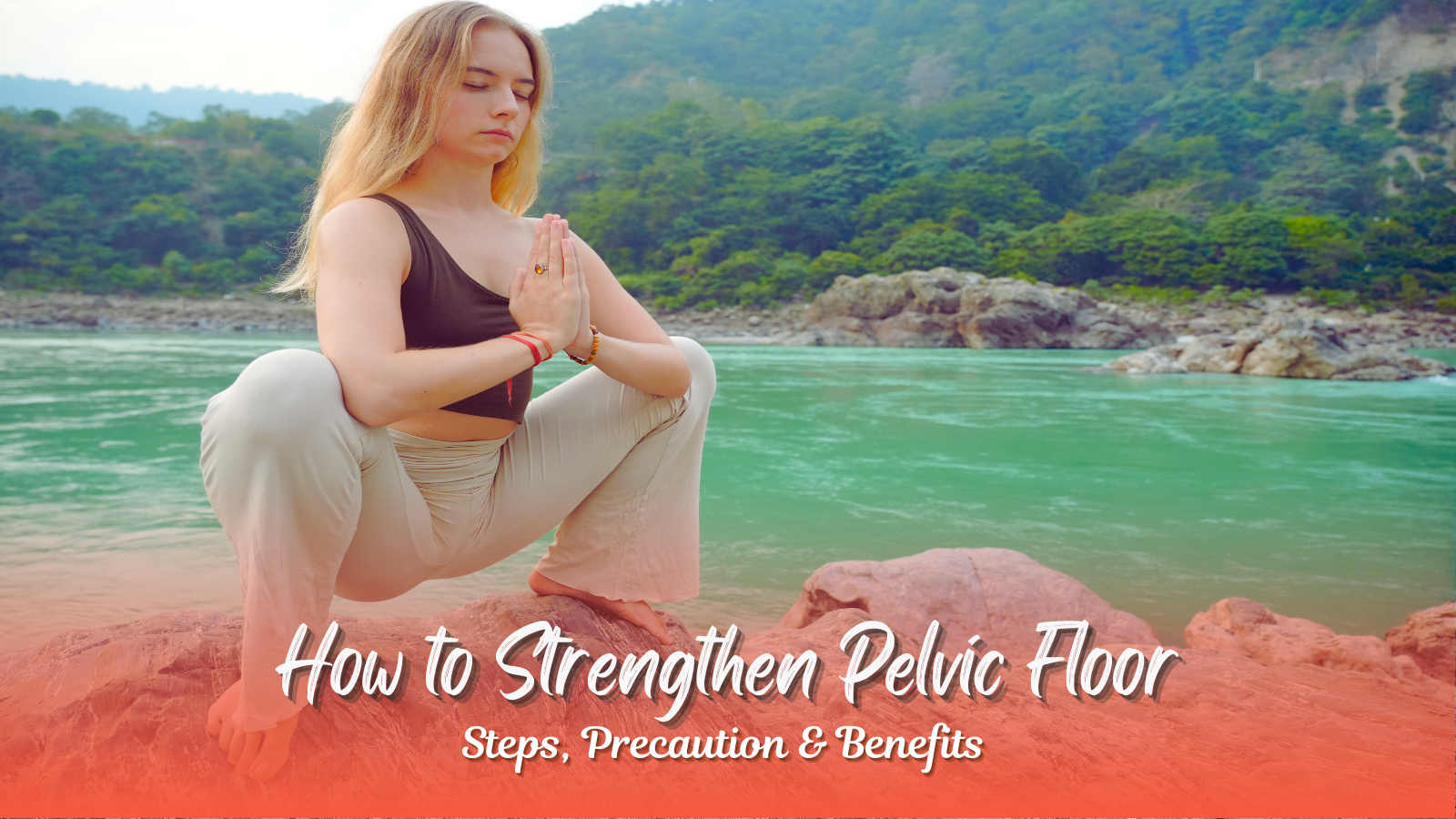
How to Strengthen Pelvic Floor: Steps, Precautions and Benefits

The pelvis is the foundation of stability and balance for the human body, but it is often overlooked or disregarded. If you are someone who wants to improve your physical stability and find emotional balance, learning to strengthen your pelvis is critical. At Gurukul Yogashala, we believe that health begins at the source. If you want to reset your mind and body with a 14-day yoga retreat in rishikesh, or are interested in improving your yoga practice through Yoga Teacher Training in rishikesh, strengthening your pelvic floor is an important aspect of developing your overall health.

Understanding the Pelvic Floor

The pelvic floor is a funnel-shaped group of muscles that support your bladder, bowel, uterus and all other organs of your pelvis. You can think about your pelvic floor like a hammock; it holds everything in place. Building strength and flexibility in the muscles of your pelvic floor will help you create a stable core, improve your sexual health and help you to eliminate waste from your body more efficiently.

Alignment and Posture Guide: The Foundation of Strength

In order to properly exercise, one must first address proper alignment. If you have postural problems, such as slumping your shoulders or having an excessive arch in your lower back, you are stressing your pelvic floor more than necessary. 

  • Neutral Position: Standing with your feet at hip width, make sure that your tailbone is neither tucked too far under nor sticking out too far behind your body. 
  • Stacked Spinal Posture: Make sure your ears are aligned over your shoulders, your shoulders are aligned over your hips, and your hips are aligned over your ankles. This “stacked” posture allows the diaphragm and pelvic floor to move together in a coordinated manner. 
  • Posture while sitting: When you are sitting, you want to be sitting on your sit bones (ischial tuberosities), not your sacrum, in order to maintain the natural curvature of the lumbar spine.

Steps to Strengthen the Pelvic Floor

1. Identification (The “Lift”)

Before strengthening the pelvic floor muscles you need to be able to identify them. An example of identifying your pelvic floor is to use the feeling of trying to stop your pee from coming out, or holding in gas…. You should be squeezing and lifting in your pelvic floor muscles as opposed to pushing down. 

2. The Slow Squeeze (Endurance)

  • Begin squeezing the pelvic floor muscles. 
  • Hold for 3-5 seconds while breathing normally. 
  • Relax for 5 seconds. 
  • Repeat 10 times. 

3. The Quick Squeeze (Power)

  • Squeeze and release the pelvic floor muscles as quickly as possible. 
  • Repeat 10-15 times. 
  • This type of exercise will train your pelvic floor muscles to respond to sudden stress, such as when you sneeze or cough.

Yoga for Pelvic Floor Health

Yoga has a well-rounded way to support pelvic health through breathing and physical activity. The 200 hour yoga teacher training in Rishikesh will focus on how these asanas form a complete therapeutic therapeutic practice.

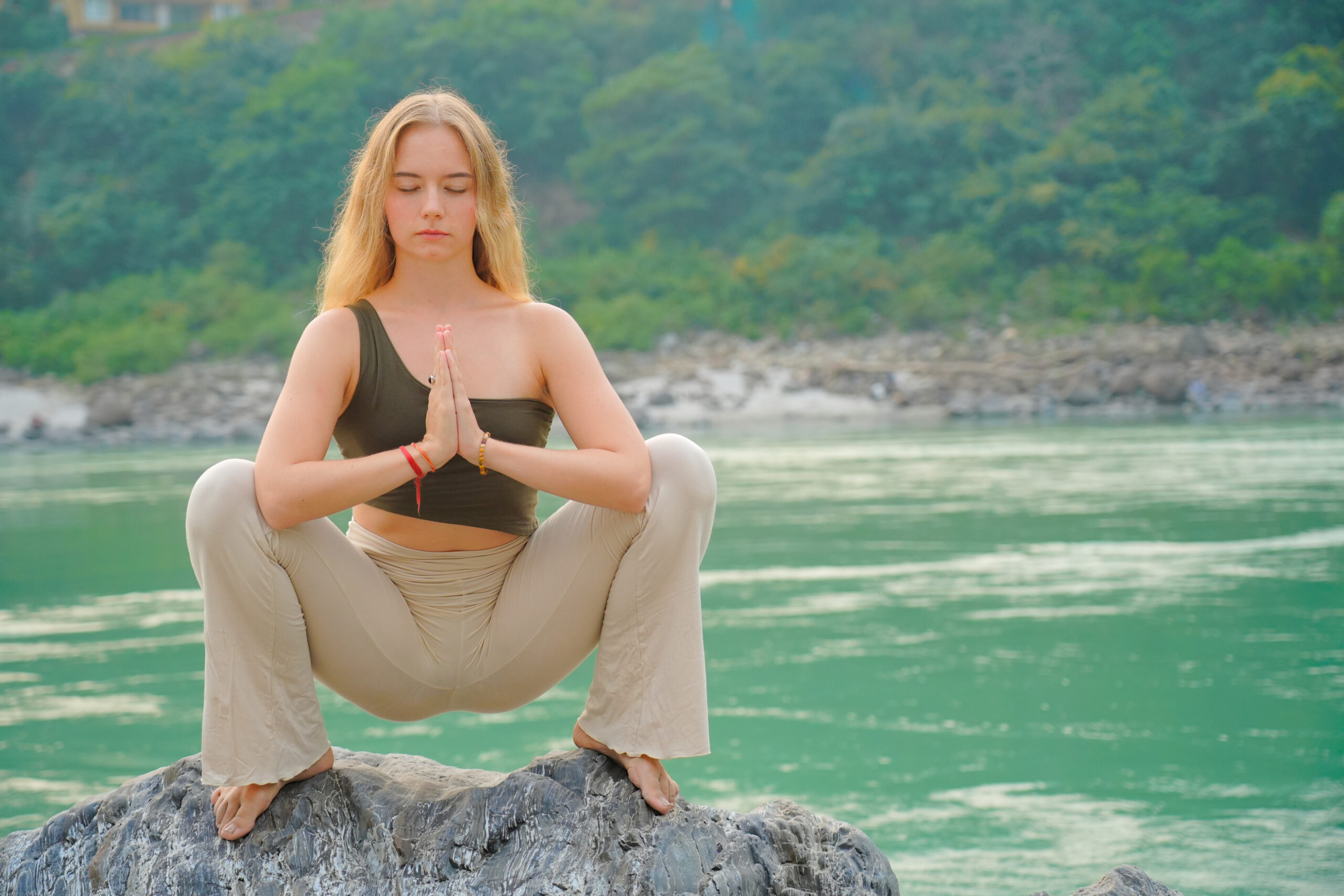
  • Malasana (Garland Pose) – This deep squat stretches the pelvic floor and also tones it. Apana vayu is encouraged to flow down through the body.
  • Setu Bandhasana (Bridge Pose) – By raising the hips, we bring both the gluteus and pelvic floor into active control.
  • Virabhadrasana II (Warrior II) – Strongly develops the stability of the pelvis and supports the adductors as they stabilize and strengthen the pelvic floor.
  • Baddha Konasana (Bound Angle Pose) – This asana is amazing at opening the hips and relieving tightness in the pelvic area. 
How to strengthen pelvic floor | Gurukul Yogashala

Exercise and Functional Training

In addition to the asanas, following are some functional exercises that will be helpful to the reader:

  • Hip lunges – These exercises help strengthen the pelvic muscles, thereby strengthening the external pelvic structures.
  • Bird-dog – This core exercise supports the pelvic floor by teaching the core muscles to keep the trunk stable while moving the limbs.
  • Resistance band squats – This exercise has a resistance aspect that will activate the deep stabilizers of the hip along with the pelvic floor. 

Meditation and Breathwork

Your Pelvic floor moves with your Diaphragm. The pelvic floor releases as you breathe in, and lifts as you exhale.

Meditation Technique

From a comfortable position, close your eyes, envisioning your pelvic floor as a lotus flower, blooming as you inhale, and gently closing as you exhale. This Biofeedback Meditation technique encourages reduced hypertonicity (excess tension) of muscles. 

Chakra Healing: Muladhara and Swadhisthana

Chakras (energy centres) are a key component of your pelvic health. As taught at Gurukul Yogashala;

Muladhara (Root Chakra)

The Muladhara (Root) chakra is located at the base of your spine and associated with the element of earth. It is responsible for feelings of safety and security. A weak pelvic region can manifest as an unstable foundation, resulting in feelings of anxiety, while strengthening this area supports grounding the energy in your body.

Swadhisthana (Sacral Chakra)

The Swadhisthana (Sacral) chakra is located above your pubic bone and is responsible for your creativity, emotions, and reproductive health. Working on the pelvic region will release any blockages in this energy centre and regulate your emotions, thereby enhancing your vitality. 

Benefits of a Strong Pelvic Floor

  • Urinary/Bowel Control: Prevents urinary/bowel incontinence and prevents the urge to go.
  • Core Strength: Creates a strong base of support for the abdominal muscles.
  • Improving Recovery: Essential for recovery after delivery and for supporting pelvic organs.
  • Improved Sexual Satisfaction: Increased blood flow and control of the muscles improve your sexual experience.
  • Postural Stability: When you support the spine below, you can reduce chronic lower-back pain. 

Precautions to Consider

  • Avoid Bearing Down: Do not apply excessive pressure to your pelvic region when trying to have a bowel movement; doing so will weaken the pelvic floor muscles and cause prolapse.
  • Do Not Breath Hold: Keep your breathing steady to manage intra-abdominal pressure while performing exercises.
  • Avoid Overuse: The pelvic muscles will become fatigued or hypertonic (too tight) just like any other muscle. A balance of strength and relaxation should be maintained.
  • Contact a Professional: If you have sharp pain, or you have been diagnosed with a prolapse, contact a physiotherapist for help with your pelvic floor. 

Final Thoughts

Focusing on developing a strong pelvic region goes beyond simply having strong muscles; having a solid support system underpins the entire human body. By paying attention to proper posture, doing yoga, and understanding what energy resides in your body, you will create a healthier lifestyle and be able to connect better with your body through grounding techniques.

Whether you are going about your day or learning more at a Yoga Teacher Training in Rishikesh, keep in mind that having a good pelvic floor allows you to move freely and gives you a sense of peace within your physiological self, so continue to improve yourself gradually.

We believe that when your base is established, your physical, mental and spiritual well-being will thrive at Gurukul Yogashala.

FAQ

1. What is the fastest way to strengthen the pelvic floor? 

To see results within four to six weeks, do both ‘slow lifts’ and ‘quick squeezes’ (Kegels) three times a day. 

2. Which yoga poses help strengthen the pelvic floor naturally? 

The following are just a few: Malasana (squatting position), Setu Bandhasana (bridge) Utkatasana (chair). All of these poses utilize gravity and alignment to give your pelvic stabilizers an opportunity to work naturally. 

3. How does posture (alignment) affect pelvic floor strength? 

Once the pelvis is in either an anterior tilt or posterior tilt, your pelvic region muscles are too ‘overstretched’ or too ‘bunched up’ for them to contract properly. When you are properly aligned with your pelvis, your pelvic floor muscles will be at their optimal lengths to produce power. 

4. What are the benefits of strengthening the pelvic floor? 

In addition to preventing leakage, if your pelvic floor is strong it will assist in supporting your spine and reducing back pain, increase sexual pleasure and help you feel more “grounded” emotionally (i.e., through the root chakra). 

5. What precautions should I take while doing pelvic floor exercises? 

When performing pelvic exercises, remember not to clench your breath, glutes or thighs tightly. Only work on internal motion. Stop and realign your posture if you cannot feel any pressure coming downward versus upward. 

6. Can meditation help improve pelvic floor strength? 

Yes, meditation can assist in the identification of chronic tension held within the body. Stress is commonly stored in the pelvis; thus through calming the mind, one can relieve hypertonic muscles, allowing for better functioning and strengthening of those muscles. 

7. How are the Muladhara and Swadhisthana chakras connected to pelvic health?

The Muladhara (root) and Swadhisthana (sacral) chakras work together to support pelvic health. The Muladhara creates a stable base for the body, while the Swadhisthana governs the fluid movement and reproductive aspects of the pelvic area. By creating balance in both of these chakras, you create stable and flowing energy in the pelvic region. 

8. What are simple daily exercises to improve pelvic floor strength? 

The elevator exercise is a simple way to build strength in the pelvic floor on a daily basis. Visualize your pelvic floor as an elevator: First, lift yourself up to the first floor; then to the second; and finally to the third. Hold on the third floor for a moment, and then lower down to the first floor again. This can be done while brushing your teeth or waiting for your coffee!

Women

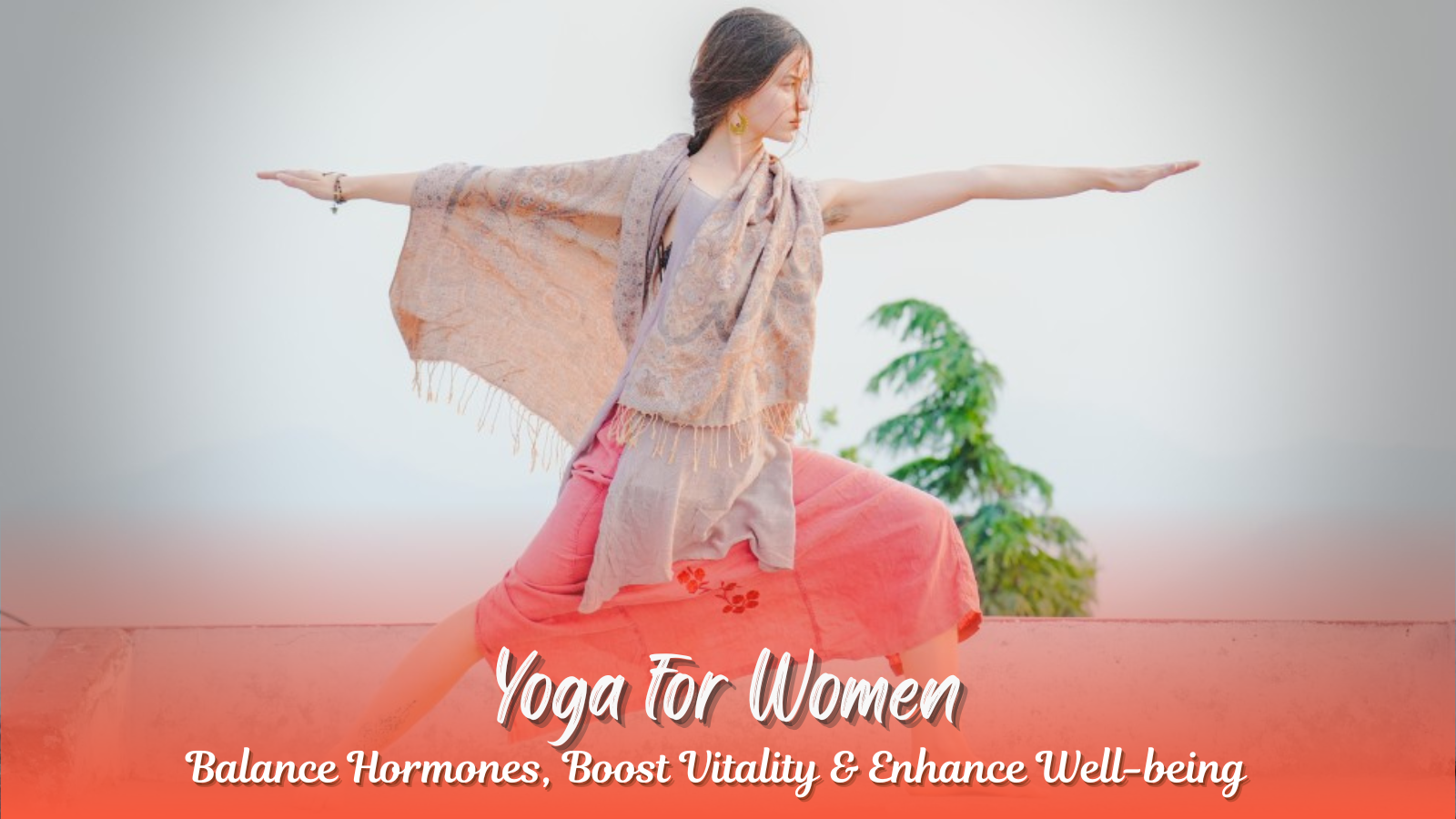
Yoga for Women: Balance Hormones, Boost Vitality & Enhance Well-being

Yoga for women is more than physical exercise—it’s a holistic practice that balances hormones, supports fertility, eases menopause and improves mental well-being. Yoga is more than just physical exercise—it’s a complete system for physical, mental and emotional well-being. For women, yoga can be especially beneficial during all stages of life—puberty, menstruation, pregnancy, motherhood, menopause and beyond. In this article, we’ll explore the powerful impact of yoga for women, including its benefits, role in hormone balance and how you can start practicing—even from home. We’ll also look at the best yoga teacher training india programs in Rishikesh, India—the world capital of yoga.

Why Yoga Is Important for Women’s Health & Hormonal Balance

Researchers have studied how practicing yoga for women can help with many health problems, including some that affect women specifically. Yoga is known to improve both physical and mental health. It can help with stress, hormonal balance, menstrual issues and even problems like PCOS and menopause symptoms. Regular yoga practice also supports better sleep, digestion and overall energy. That’s why more and more women are adding yoga to their daily routine for a healthier and happier life.

Yoga for Women at Every Age: From Adolescence to Menopause

Yoga for women is for every age and every stage of life. Whether you’re a teen, a new mom or enjoying your golden years, yoga supports your body and mind in unique ways. The key is to make yoga a regular part of your routine. With daily practice, even simple poses and breathing exercises can bring powerful changes. No matter your age or lifestyle, yoga can help you feel healthier, calmer and more connected to yourself.

Yoga for Women & Teen Girls: Balancing Hormones Naturally
Adolescence brings many physical and emotional changes for young girls and yoga can help make this transition smoother. Breathing techniques and gentle asanas calm the mind, balance hormones and support a healthy menstrual cycle. Regular practice also builds strength and encourages a positive body image from an early age.

Prenatal & Postnatal Yoga: Benefits for Pregnancy and Motherhood
During the years of pregnancy and motherhood, yoga for women stay strong, flexible, and emotionally balanced. Prenatal yoga supports the body through physical changes, eases back pain and prepares for a smoother delivery. After childbirth, gentle yoga and breathing practices help the body heal, restore strength and support milk production.

Yoga for women, Menopause Relief & Midlife Balance
This stage brings changes like menopause, weight gain, and hormone imbalance. Yoga helps manage these changes by reducing stress, balancing hormones and supporting overall health. Simple breathing and meditation practices also calm the mind during this time.

Yoga for women change their life | Best Yoga Teacher Training School in Rishikesh, India | Gurukul Yogashala

Yoga for Women; Senior Citizen: Staying Active, Calm & Flexible
As women grow older, yoga for women can help them stay active, relaxed and mentally calm. Gentle poses improve blood flow, support the nervous system and reduce stiffness. At this stage, yoga focuses on keeping the body flexible and the mind peaceful, bringing a sense of balance and well-being.

Key Benefits of Yoga for Women’s Health & Wellness

Flexibility and Balance

Regular yoga practice helps improve how flexible and steady your body feels. This is helpful for everyone—from young people to older adults—and can lower the risk of injuries during daily activities or exercise.

Mental Health

Yoga connects your body and mind, which helps calm stress and lift your mood. It can also reduce anxiety and help you feel more relaxed and positive.

Improved Sleep

Yoga helps you unwind, which makes it easier to fall asleep and wake up feeling fresh. With less stress and more calm, you’re likely to enjoy deeper, better-quality sleep.

Prenatal Benefits

Yoga during pregnancy can ease back pain and reduce stress. It also helps you stay active in a gentle way, but it’s always best to check with your doctor first.

PMS Symptoms

Yoga can ease monthly discomfort like cramps, mood swings and tiredness. Many women find that yoga works better than regular workouts to reduce PMS symptoms.

Menopause Relief

Yoga may help reduce hot flashes, night sweats and mood changes during menopause. It also supports better sleep and emotional balance during this time of change.

Bone Strength

Practicing yoga for women regularly may help strengthen your bones and lower the risk of bone loss. Even just a few minutes a day can support long-term bone health.

Stay Active for Better Yoga for Women’s Health

Yoga is a great way to stay active, but the key is finding something you enjoy. Talk to your Yoga teacher or doctor to choose the best type of movement for your body and lifestyle.

How Yoga Helps Hormonal Imbalance in Women Naturally

Hormones control many functions in a woman’s body, such as mood, metabolism, menstrual cycle, fertility & more. When hormones are out of balance, it can lead to:

  • Irregular periods
  • PCOS (Polycystic Ovary Syndrome)
  • Weight gain
  • Fatigue
  • Mood swings
  • Acne
  • Insomnia

How Yoga for Women Helps Balance Hormones Naturally:

  1. Reduces Cortisol (Stress Hormone): When the body is under constant stress, it produces too much cortisol, a stress hormone. This can lead to health problems like weight gain and diabetes by making it harder for the body to use insulin properly and by causing fat to build up. Overproduction of cortisol affects other hormones like estrogen and progesterone. Yoga for Women calms the mind and lowers cortisol.
  2. Improves Thyroid Function: Practicing yoga poses along with breathing exercises has been shown to improve thyroid function. People with thyroid problems experienced better hormone levels after regular yoga practice. Yoga for women also helps the body relax and lowers stress. Since stress can make thyroid issues worse, yoga can be a helpful natural support for thyroid health. Poses like Shoulder Stand and Fish Pose stimulate the thyroid gland.
  3. Supports Reproductive Health: Practicing yoga for women regularly affects reproductive hormones, including estrogen, progesterone and testosterone, which play essential roles in menstrual cycle regulation and fertility. Hip-opening and pelvic-toning poses improve blood flow to the uterus and ovaries.
  4. Balances Insulin Levels: Useful in managing PCOS and preventing diabetes. Doing yoga helps control blood sugar levels and manages weight, which is very important for people with diabetes. The calming and mindful part of yoga also helps reduce stress eating and improves emotional balance, making it a complete and natural way to support diabetes care.
  1. Improves Metabolism and Energy: Doing regular physical activity like yoga can help boost your metabolism and support the release of important hormones that control energy and hunger. Leptin, made by body fat, helps manage appetite and energy balance. Ghrelin, also known as the “hunger hormone,” tells your brain when you’re hungry. Yoga for women can help keep these hormones in better balance. A healthy gut supports better hormone absorption and energises the body.

Recommended Yoga Asanas for Hormonal Balance:

Prenatal Yoga for Women: Benefits, Safety & Best Poses

Pregnancy is a phase in women’s life which changes her physically, mentally, emotionally and spiritually for the rest of her life. To balance all these aspects and have a normal and complication-free pregnancy, yoga can help women stay physically and emotionally strong. It prepares the body for childbirth and supports the baby’s health.

Benefits of Prenatal Yoga:

  • Improves flexibility and strength of spine for labor
  • It strengthen pelvic floor muscles and reduces muscle cramps during third trimester
  • Reduces lower back pain and leg cramps
  • Strengthens the bearing down muscles and helps in the expulsion of fetus.
  • Enhances breath control (useful during delivery)
  • Improves sleep
  • Reduces anxiety and promotes calmness
  • Supports bonding with the baby
  • Provides  extra  oxygen  to  every  cell  and rejuvenates them.
  • Tones up nervous system and improves emotional stability.
  • Relives morning sickness and mood swings

Different kinds of asanas are prescribed according to the stages of pregnancy. That’s why it is very important to consult your and practice it under the guidance of a qualified Prenatal & Postnatal yoga teacher. Pregnant women should always practice gently, avoid overexertion and listen to their bodies. Focus on breathing, relaxation and stability rather than intensity. Avoid poses that put pressure on the abdomen, involves deep twists or lying flat on stomach. Always use props for support, stay hydrated and stop immediately if you feel discomfort.

Beginner Yoga for Women: Simple Poses to Start at Home

Starting yoga is easy and doesn’t require any fancy equipment. To practice yoga at home, a yoga mat, comfortable clothes and a quiet space are all you need.

Some of the Simple Beginner Yoga Poses for Women to practice at home:

  1. Mountain Pose (Tadasana) – Improves posture
  2. Tree Pose (Vrikshasana) – Boosts balance
  3. Downward Dog (Adho Mukha Svanasana) – Tones the whole body
  4. Warrior I & Warrior II (Virabhadrasana I & II) – Builds strength and confidence
  5. Cat-Cow Pose – Improves spine health and hormone flow
  6. Savasana (Corpse Pose) – Deep relaxation

Tips for Women Starting Yoga at Home:

  • Start with 15-20 minutes daily
  • Focus on breathing
  • Use beginner videos or join online classes
  • Be consistent
  • Respect your body’s limit

Best Daily Yoga Asanas for Women’s Health & Hormonal Balance

  1. Sun Salutations (Surya Namaskar) – Full-body workout
  2. Seated Twist – Aids digestion and detox
  3. Camel Pose – Opens chest, improves mood
  4. Butterfly Pose – Supports reproductive organs
  5. Corpse Pose – Deep relaxation

Yoga Teacher Training in Rishikesh for Women: 100, 200 & 300 Hour TTC

If you want to deepen your practice or become a certified yoga teacher, Rishikesh is the best place to start. Known as the Yoga Capital of the World, Rishikesh is located in the foothills of the Himalayas beside the holy Ganga River. It offers authentic training with experienced teachers, spiritual energy and a peaceful atmosphere.

Many people who join yoga programs, especially in places like Rishikesh, discover how deeply yoga supports overall health—especially for women. At a Yoga School in Rishikesh, students learn not only yoga postures but also how yoga can improve women’s physical, mental and hormonal well-being. The 200 Hour Yoga Teacher Training in Rishikesh and 300 Hour Yoga Teacher Training in Rishikesh help women understand the connection between yoga and key health areas like hormonal balance, menstrual health and stress relief. Even shorter courses like the 100 Hour Yoga Teacher Training in Rishikesh & Prenatal and Postnatal Yoga Course include practices and knowledge that support women’s health at every stage of life.

FAQs

1. How does yoga help in improving women’s health?

Yoga supports women’s health by reducing stress, balancing hormones, improving flexibility and boosting overall energy. It also helps manage issues like PMS, PCOS, menopause symptoms and anxiety.

2. Can beginners join a yoga teacher training in Rishikesh?

Yes! Beginners are welcome to join the 100-hour or 200-hour Yoga Teacher Training in Rishikesh. These courses start with the basics and gradually build up your knowledge and practice.

3. Is yoga safe for women during pregnancy?

Yes, yoga can be safe during pregnancy, especially prenatal yoga. However, it’s important to consult your doctor and practice under the guidance of a trained teacher who understands pregnancy yoga.

4. What are the benefits of joining a yoga course in Rishikesh for women?

Rishikesh offers authentic yoga training in a peaceful environment. Women benefit from learning both physical postures and emotional well-being techniques, with a focus on self-care and healing.

5. Can yoga help with hormonal imbalance in women?

Yes, regular yoga practice can help regulate hormones naturally. It supports better thyroid function, reduces cortisol (stress hormone), and improves overall hormonal balance.

Conclusion: Why Every Woman Should Practice Yoga Daily

Whether you are a student, working professional, mother or grandmother—yoga is for every woman. It supports your health, hormones, emotional balance and energy levels. You don’t need to be flexible or experienced to start. All you need is a little time, commitment and the will to take care of yourself.

For those who want to go deeper, consider joining a Yoga Teacher Training in Rishikesh to transform your life and help others too.

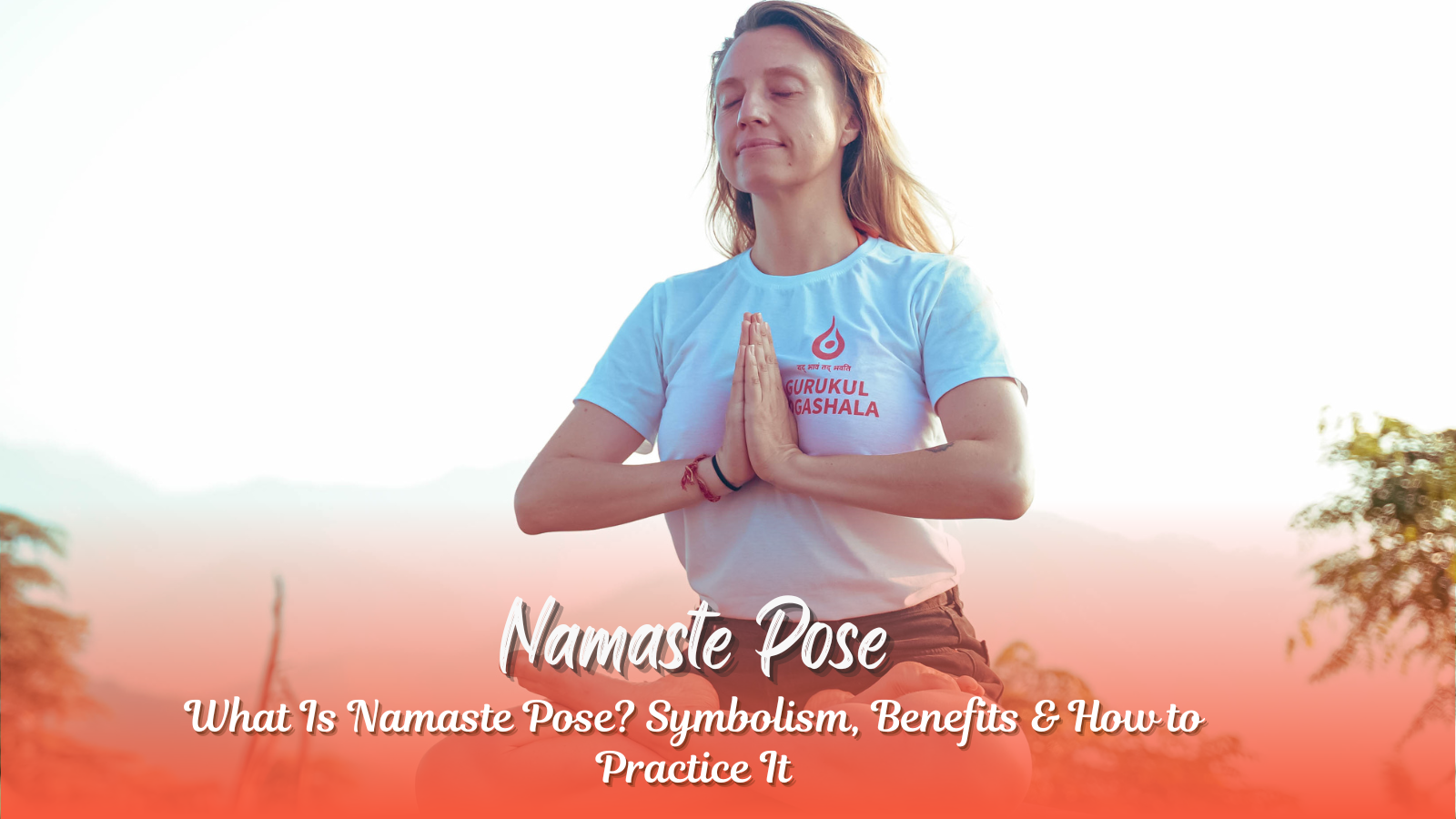
Namaste Pose Yoga Hands Gesture Yoga Teacher Teaching Namaste Pose

What Is Namaste Pose? Symbolism, Benefits & How to Practice It

What Is Namaste Pose? Symbolism, Benefits & How to Practice It

In yoga practices, sacred gestures exist that go beyond body positions and introduce deep spiritual and mindful traditions reflecting cultural heritage. Throughout a variety of settings and rituals, Namaste Pose maintains its place as a significant, powerful symbol. The Namaste Pose stands as a simple yet major symbolic gesture that people commonly use for yoga classes and spiritual sessions and ordinary everyday interactions. The Sanskrit name Anjali Mudra embodies unity, together with humility and inner peace, which form the foundation of yoga when used as Namaste Pose.

Your understanding of the Namaste posture will bring significant transformation to your yoga practice, regardless of where you stand as a beginner or experienced practitioner. Through its symbolic nature, Namaste functions as both a physical body position that links the practitioner to greater forces, yet also connects them to universal unity and personal self.

This detailed guide examines Namaste Pose meaning alongside its historical roots and religious significance, together with its health advantages as well as different performing techniques and instructions for practicing it. Understanding Namaste Pose requires studying at the Best Yoga School in Rishikesh or participating in a Yoga Teacher Training in India, where one can discover its significance in the field of yoga pose names.

What is the Namaste Pose?

Performing Namaste Pose means holding Anjali Mudra position by elevating the palms towards the Anahata Chakra heart center while creating a prayerful union in front of the body. People use this hand stance together with head bowing while shutting their eyes to demonstrate respect alongside humility.

The Namaste pose yoga begins with this hand position before and after practice to respect self and others as well as honor mindfulness and gratitude. This gesture currently exists in global culture as it stands as a customary form of respect in spiritual practices and meditative ceremonies.

Namaste posture provides practitioners with two key functions by establishing a foundation in body posture while representing our fundamental bond with others. The pose merges the body with inhalation and focus, which reflects the core principles of yogic wisdom.

The educational approach in various yoga schools in India incorporates this gesture as a regular spiritual routine for their students participating in Yoga Teacher Training programs in Rishikesh.

What Does Namaste Mean in Yoga?

Namaste is a Sanskrit combination of “Nama” which means bow and “Te” which represents you, so it carries roughly the meaning of “I bow to you”. By expressing Namaste, a person acknowledges the divinity that resides within another person.

The Deeper Symbolism:

  • Spiritual Connection: Namaste expresses the divine essence that exists within every person because of the universal connection between them. According to yogic beliefs, every being maintains a universal connection through the sharing of universal consciousness.
  • Respect and Humility: Namaste represents both a symbolic gesture and physical action which manifests respect and humble acknowledgment while strengthening mutual relationships between teachers and their students or between any individuals who perform it.
  • Inner Peace and Unity: Through this pose, one finds inner peace while building unity by directing attention toward the heart area to preserve our inner center.

The Three Meanings of Namaste:

  • Recognition of the Divine Within: Honoring the sacred in others.
  • Connection of Souls: A shared understanding exists that all souls rest within a single connection.
  • Gratitude and Respect: A symbolic offering of peace and kindness.

The Yoga School in Rishikesh teaches an elaborate version of these concepts while respecting their spiritual elements and symbolic practices.

What Is the Gesture at Namaste?

The traditional Anjali Mudra gesture, which people refer to as Namaste, represents more than a static body movement. This pose links both the material world and spiritual consciousness. This gesture unites gestures and breath alongside the alignment of subtle energies with body movement. Here’s how it’s typically performed:

  • Position yourself either standing or sitting in an easy posture.
  • Place your palms in front of the heart center point.
  • Holding your breath, you should gently bow your head downward while keeping your eyes shut.
  • Take in a complete deep breath through your nose while expressing the air slowly while you concentrate on your heart area.

The ritual hand placement is a standard component in numerous yoga poses names, and their associated sequences because it is used most prominently during initial standing Namaste poses or during final meditative postures.

Advanced practitioners use this sacred gesture to improve focus and grounding during their body flex transition and other poses.

Physical and Spiritual Benefits of Namaste Pose

The benefits of Namaste Pose provide multiple advantages that exceed physical exercise parameters. Namaste Pose constitutes a practice that creates harmony between your physical body and mental state, emotional processes and spiritual nature.

1. Promotes Mindfulness and Inner Stillness

Your practice of mindfulness develops through the Namaste pose by keeping awareness of the present moment. Through this pose, people can experience updated mental clarity, which brings them to full focus on the present moment during their practice times or daily activities.

2. Center Energy at the Heart Chakra

Anahata functions as the heart chakra, which serves as the center for emotional sensations of compassion and love according to yogic anatomy principles. You will activate and bring alignment to your heart chakra by placing your palms on this area, which leads to emotional equilibrium.

3. Improves Body Awareness and Posture

During the standing Namaste Pose, drawing the shoulders backward together with spine extension helps people maintain better body alignment and proper posture.

4. Enhances Respect and Gratitude

Through this physical position, the body demonstrates honor for others as well as for oneself. The Namaste attitude stands as a vital cornerstone of yoga ethics (Yamas and Niyamas).

5. Cultural and Spiritual Connection

The Namaste gesture increases your understanding of the cultural heritage of yoga. The practice ties you to the historical yoga heritage along with traditional practices when learning Yoga Teacher Training in India.

How to Do Namaste Pose Correctly

The Namaste Pose practice remains straightforward while generating profound effects for everyone wishing to perform it. The practice exists in three forms, including physical performance when practicing yoga, along with its use as meditation, and occurs in daily situations through hand gestures which function as silent greetings and blessings.

Steps to Practice:

  • The Namaste Pose starts from either a seated, kneeling or standing beginning position.
  • Maintain Anjali Mudra by holding your palms together at your heart center.
  • The practice requires embracing the palms with balanced pressure between them.
  • Close your eyes followed by three deep breaths.
  • Bow your head slightly as a sign of humility.
  • Inside, repeat the word Namaste by heart or speak Namaste aloud for practice.

People typically use this hand position during the movement from the rising yoga pose to meditative states or at the end of meditations. Precisely this stance will achieve a hallowed stopping point within your exercise practice while extending its significance to your everyday lifestyle.

Namaste Pose Variations

Namaste pose variations allow yoga practitioners to maintain all the different gestures and adapt to different intentions and settings:

This Namaste pose variation is performed during postures that require Tadasana for standing namaste pose and centering.

Seated Namaste Pose functions as a body position during meditation or pranayama practice to deepen breathing and mental concentration.

The gesture of Namaste at the forehead or crown revolutionised its purpose for sacred worship during spiritual prayer.

Namaste with a Deep bow serves religious and devotional yoga ceremonies alongside participating rituals.

Every energy signature and postural variation in Namaste carries distinct power that improves the entire yoga session.

Namaste Pose in Yoga Teacher Training

Different names of yoga poses contain Namaste pose as a component to symbolize transition, together with grounding or respect, among other functions.

Common poses include:

The Mountain Pose in Tadasana presents the Namaste hand gestures to maintain stillness along with proper alignment.

With Namaste hands held in balance and focus position, we perform Vrksasana (Tree Pose)

Using Namaste hands, skeptical people can detoxify their body while opening their chest through Revolved Prayer Twist.

Various yoga poses names can use Namaste Pose together with other components, so this posture stands as an extremely adaptable name in contemporary and classical styles of yoga.

People studying movement arts can recognize universal spiritual and emotional communication through a comparison of ballet poses names and yoga body positions.

Deepening Your Practice: Yoga Schools in India

Studying at a Yoga School in India provides the best opportunity to learn Namaste Pose and embody its essence. Students find the Best Yoga School in India offers an optimal environment because it is situated next to the Ganges River, inside the Himalayan natural surroundings along the holy river.

Why Rishikesh?

Rishikesh positions itself as the main spiritual center for all matters related to yoga. The Namaste Pose at sunrise, in combination with Sanskrit yoga poses names learning, and cave meditation, establishes a deep source connection to yoga.

Yoga Teacher Training in Rishikesh

The physical boundaries of a Yoga Teacher Training course, either in Rishikesh or another Indian location, offer both personal practice enhancement and training to become an instructor. You’ll explore:

  • Alignment and anatomy of poses like Namaste
  • Philosophy and ethics behind gestures and postures
  • Mantras, meditation, and pranayama

These programs teach people to embrace the Namaste posture as a comprehensive lifestyle system.

FAQs About Namaste Pose

What is the Namaste Pose?

People use Anjali Mudra as a hand gesture to join their palms at the heart while practicing yoga and demonstrating respect as well as spiritual connection.

What is the benefit of Namaste Asana?

The practice encourages mindfulness while improving posture, it centers energy and strengthens mutual respect, together with gratitude expression.

What is the gesture at namaste?

People use both their physical posture of palm-to-palm chest placement with head bow and sometimes eye closure to enhance their spiritual awareness.

What are the 3 meanings of Namaste?

Recognition of the divine, mutual respect and return to inner peace.

What is the ritual of Namaste?

When used traditionally, these prayers serve to generate and conclude yoga sessions and spiritual meetings for expressing connection and gratitude while maintaining humility.

Final Thoughts

Ready to explore yoga deeper? Join our 200 Hour Yoga Teacher Training in Rishikesh at Gurukul Yogashala.

Through the Namaste Pose, practitioners embody more than conventional hand movements because it serves as an honored spiritual expression from the yogic tradition. Indian cultural practices gave birth to Namaste, which then became a global element recognized in contemporary yoga studios, where it perpetuates spiritual reverence and a sense of connection and peace.

The Namaste pose will give depth to your everyday life when you practice it and study it more deeply at a Best Yoga School in Rishikesh while respecting yoga’s rich historical heritage.

Your hand gesture, along with your lowered head, serves as more than a movement because it represents a combined message about unity, combined with light and love.

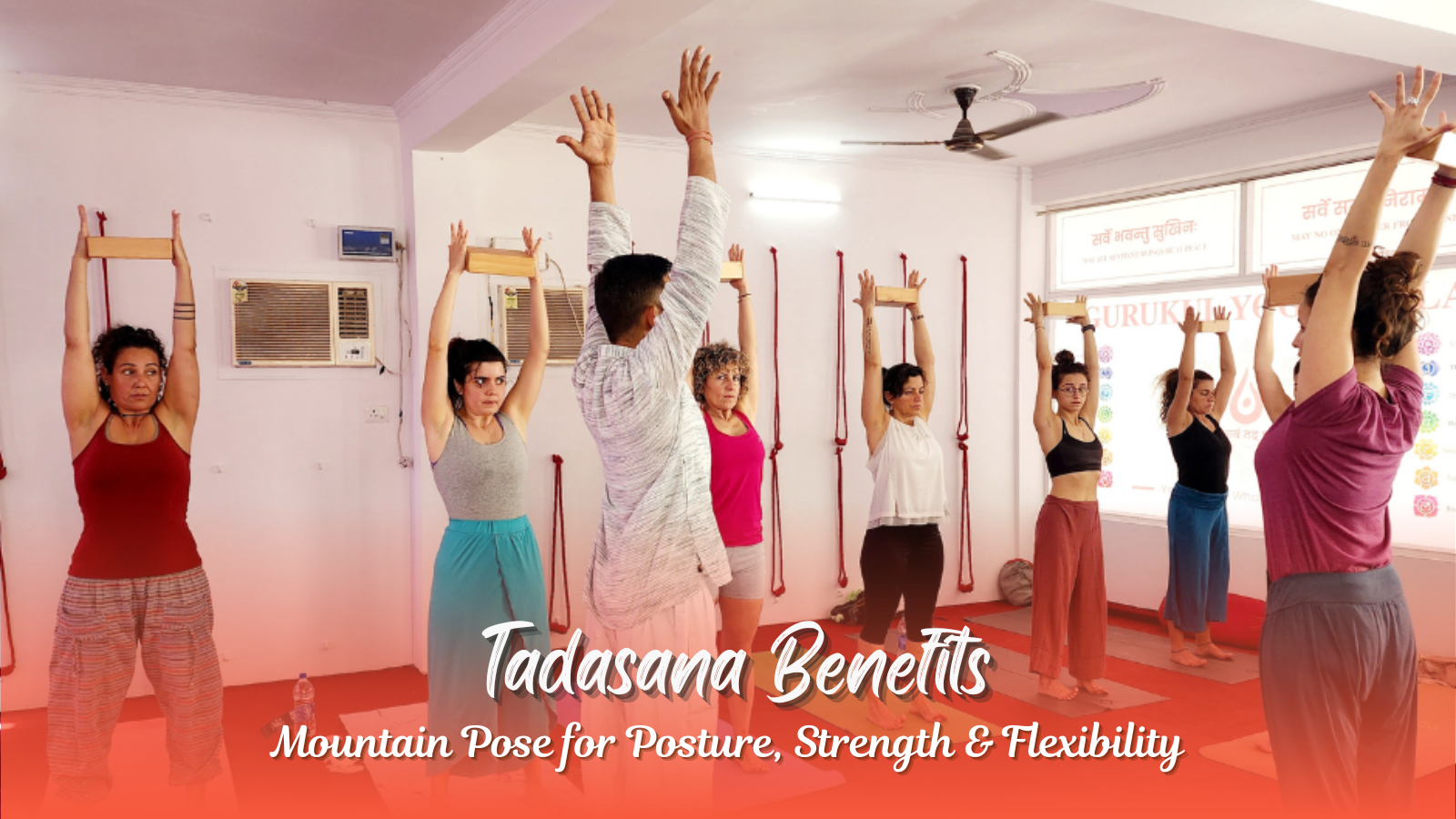
Tadasana yoga pose - Proper posture demonstration Mountain pose tadasana step by step guide Tadasana benefits - How it improves strength and flexibility

Tadasana Benefits for Posture, Mental Health, Strength & Flexibility

Introduction to Tadasana (Mountain Pose)

Tadasana, also known as the Mountain Pose, is one of the foundational postures in yoga. It may seem simple, but it offers a range of benefits for posture, Tadasana benefits, strength and flexibility. Regular practice of Tadasana yoga pose can help improve balance, increase focus, and enhance overall body alignment.

Whether you are a beginner or an advanced yogi, understanding the benefits of Tadasana and the correct way to perform it is essential. This guide will cover the Tadasana meaning, steps, Tadasana benefits, contraindications, and variations to help you master this fundamental yoga pose.

Explore more about Tadasana Benefits.

What is Tadasana?

The word Tadasana is derived from the Sanskrit words:

  • Tada” meaning “mountain”
  • Asana” meaning “posture”

Thus, Tadasana (Mountain Pose) represents the stability and groundedness of a mountain, promoting strength and balance in the body. It is the starting position for many standing yoga poses and is an essential component of yoga teacher training programs in Rishikesh and across the world.


Tadasana Benefits For Physical and Mental Health

Practicing Tadasana yoga pose daily can bring several physical and mental benefits. Here are some of the key Tadasana benefits:

1. Improves Posture

  • Helps maintain a straight spine
  • Corrects postural misalignment
  • Enhances body awareness

2. Strengthens Muscles & Bones

  • Engages core muscles
  • Strengthens thighs, knees and ankles
  • Improves overall body stability

3. Enhances Flexibility

4. Boosts Energy & Focus

  • Increases blood circulation
  • Enhances mental clarity and focus
  • Helps in stress relief and relaxation

5. Supports Digestion & Metabolism

  • Stimulates digestive organs
  • Aids in better metabolism
  • Helps in maintaining a healthy weight

6. Helps in Height Growth

  • Does Tadasana increase height? Tadasana benefits, Yes, when practiced regularly during growth years, Tadasana pose can improve posture and spinal alignment, aiding in height increase.

How to Do Tadasana (Mountain Pose) Correctly?

Tadasana Steps

Follow these Tadasana step-by-step instructions to practice it correctly:

  1. Start Position: Stand straight with your feet together and hands by your sides.
  2. Grounding: Distribute your weight evenly on both feet.
  3. Spine Alignment: Keep your spine erect and shoulders relaxed.
  4. Arm Position: Raise your arms overhead, keeping them parallel or joining your palms.
  5. Stretching: Lift your heels, balancing on your toes, and stretch your body upwards.
  6. Hold: Maintain the position for 10-15 seconds while breathing deeply.
  7. Return: Lower your heels and bring your arms down slowly.
  8. Repeat: Perform this 3-5 times for better results.

Precautions of Tadasana:

  • Avoid locking the knees
  • Do not strain the neck or shoulders
  • Maintain balance to prevent falls

Contraindications of Tadasana

Although Tadasana benefits the body in many ways, certain individuals should avoid this pose:

  1. People with low blood pressure
  2. Those suffering from vertigo or dizziness
  3. Individuals with severe knee or ankle injuries

Frequently Asked Questions About Tadasana

Does Tadasana Increase Height?

Yes, Tadasana (Mountain Pose) is known to help improve posture and elongate the spine, which can create the appearance of increased height. While it does not physically lengthen bones in adults, regular practice helps in stretching the spine, improving flexibility and correcting postural misalignments. For growing children and teenagers, Tadasana benefits the body by promoting better growth by stimulating the spine and increasing blood circulation.

Can Tadasana Increase Height?

Tadasana benefits can contribute to height growth indirectly by improving posture and spinal alignment. It stretches the muscles, strengthens the legs, and encourages an upright stance, making an individual look taller. In children and adolescents, where bones are still growing, practicing Tadasana along with a healthy diet and an active lifestyle may support proper growth. However, genetic factors primarily determine height, and yoga can only assist in maximizing natural potential.

What Are the Benefits of Tadasana Mountain Pose?

The benefits of Tadasana or Tadasana benefits are extensive, impacting both physical and mental well-being:

  • Improves posture: Helps align the spine and correct bad posture.
  • Increases flexibility: Stretches the entire body, making it more supple.
  • Strengthens muscles: Engages core, leg, and back muscles for improved strength.
  • Enhances balance: Develops stability and coordination.
  • Boosts circulation: Encourages better blood flow, reducing fatigue.
  • Aids in digestion: Activates abdominal muscles and helps with digestion.
  • Reduces stress: Promotes relaxation and mindfulness.
  • Supports height growth: Helps maintain a straight and elongated posture.

How to Do a Mountain Pose?

To perform Tadasana (Mountain Pose) correctly, follow these steps:

  1. Stand upright with feet together, distributing weight evenly.
  2. Keep your spine straight, shoulders relaxed and arms at your sides.
  3. Engage your thigh muscles and tuck your tailbone slightly.
  4. Inhale deeply, raising your arms overhead while keeping them parallel or palms touching.
  5. Stretch your entire body upward while keeping feet firmly on the ground.
  6. Hold the position for 30 seconds to 1 minute, focusing on deep breathing.
  7. Exhale and slowly bring your arms down to the sides.

What Are the Steps of Tadasana?

The Tadasana steps are as follows:

  • Step 1: Stand tall with feet together or hip-width apart.
  • Step 2: Engage your core and tuck in your tailbone slightly.
  • Step 3: Keep shoulders relaxed, chest open, and arms naturally beside the body.
  • Step 4: Slowly inhale and stretch your arms upward.
  • Step 5: Lift your heels slightly to balance on your toes (optional).
  • Step 6: Hold the position while breathing deeply for 30-60 seconds.
  • Step 7: Exhale and return to the starting position.

Which Organs Are Used in Tadasana?

Tadasana benefits primarily engages the spine, lungs, core muscles, and legs, benefiting the following organs:

  • Lungs: Deep breathing improves lung capacity and oxygen intake.
  • Spine: Encourages spinal alignment and flexibility.
  • Heart: Promotes better circulation and reduces stress.
  • Abdominal organs: Engages core muscles, aiding digestion and metabolism.
  • Leg muscles and joints: Strengthens thighs, calves, and knee joints.

Which Disease Is Tadasana Good For?

Tadasana is beneficial in preventing and managing several health conditions, including:

  • Postural issues – Helps correct spinal misalignment and poor posture.
  • Back pain – Strengthens core muscles, reducing lower back discomfort.
  • Arthritis – Improves joint flexibility and mobility.
  • Respiratory disorders – Enhances lung capacity and breathing patterns.
  • Stress and anxiety – Encourages relaxation and mental clarity.

Does Tadasana Reduce Belly Fat?

Tadasana benefits alone does not directly burn belly fat, but it helps in strengthening abdominal muscles and improving metabolism. When combined with other yoga asanas and a healthy diet, it can contribute to weight loss by improving posture, core engagement, and digestion.

What Are the Disadvantages of Tadasana?

While Tadasana (Mountain Pose) is generally safe, there are a few precautions:

  • People with low blood pressure may feel dizzy while holding the pose for too long.
  • Those with varicose veins should avoid standing for extended periods.
  • Individuals with severe joint pain should perform the pose under supervision.
  • If experiencing balance issues, avoid lifting heels and focus on stability first.

Why Learn Tadasana at the Best Yoga School in Rishikesh?

If you want to master Tadasana, Tadasana benefits and other foundational yoga poses, joining a Yoga Teacher Training in Rishikesh is the best choice. The Best Yoga Ashram in Rishikesh, India offers:

With expert guidance and authentic yogic teachings, you can deepen your yoga practice and become a certified yoga instructor.


Conclusion

Tadasana (Mountain Pose) is a fundamental yoga posture that enhances posture, flexibility, and strength. By practicing Tadasana yoga pose regularly, you can improve your overall well-being and prepare yourself for more advanced yoga practices.

If you are looking for the Best Yoga Teacher Training in Rishikesh, consider joining Gurukul Yogashala, where you can learn traditional yoga under experienced teachers.

Start your yoga journey today and experience the Tadasana benefits for a healthier and more balanced life!


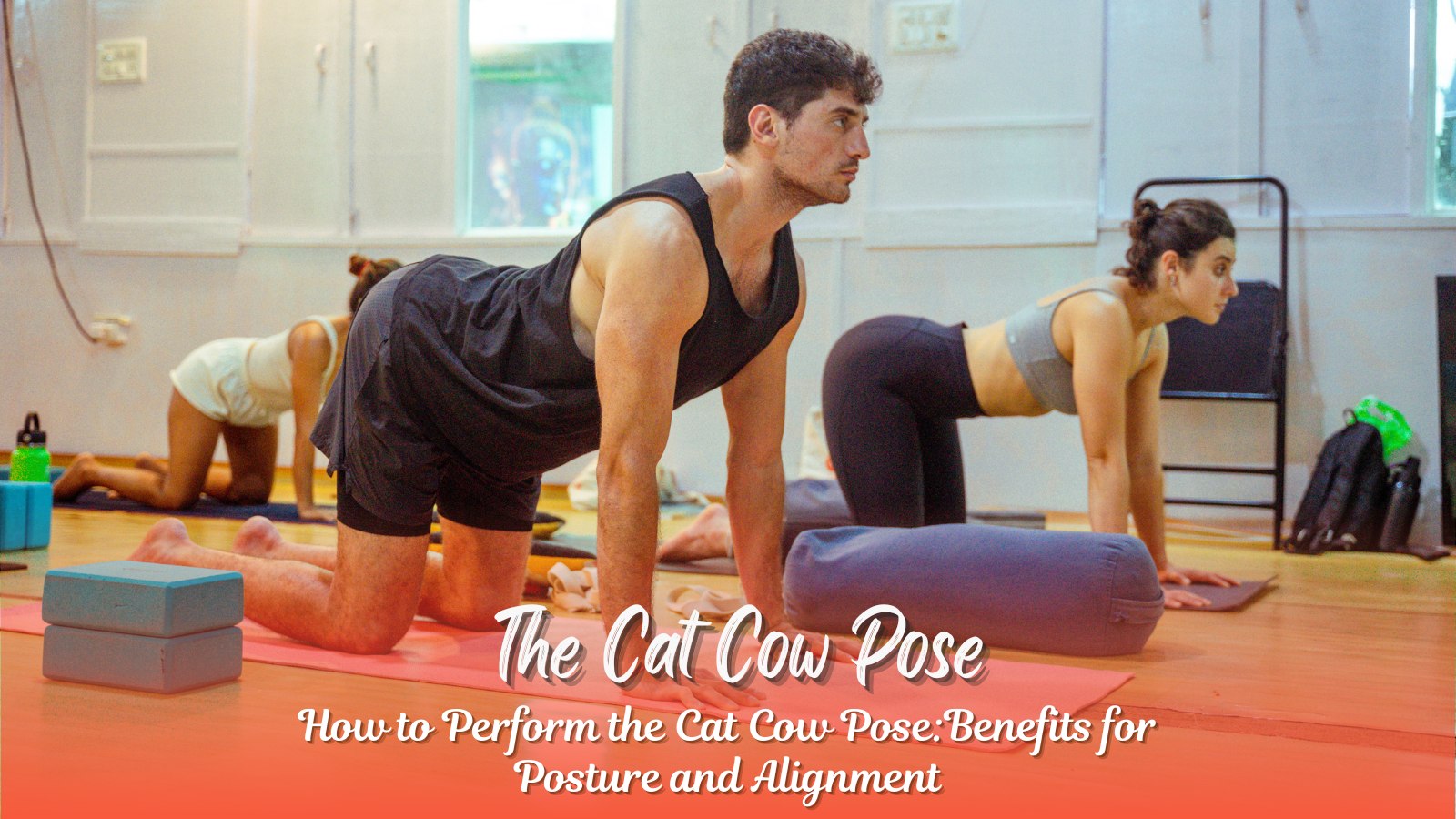
Learn how to do the Cat Cow pose (Bitilasana Marjaryasana) with our step-by-step guide. Improve posture, flexibility, and spinal mobility with this gentle flow.

How to Perform the Cat Cow Pose: Benefits for Posture and Alignment

The Cat-Cow Pose is known also as Chakravakasana in Sanskrit; it’s one of the fundamental yoga poses with several health benefits. That’s actually the flowing movement between two positions, with the rounded back of Cat Pose and the arched back of Cow Pose. It gives a flawless demonstration of working towards greater mobility and improvement in posture; thus, it is very much indispensable for all kinds of yoga practitioners.

In this blog, we will explain how to do the Cat Cow Pose, benefits of it, and modifications for people with various needs. We will also describe why this stretch is important for alignment and introduce Gurukul Yogashala’s 200 Hour Yoga Teacher Training in Rishikesh, where you can dive deeper into the practice.

What is the Cat Cow Pose?

The Cat Cow Pose, also known as Chakravakasana, is a simple yet powerful yoga sequence that involves two contrasting positions, Cat Pose and Cow Pose. These movements are done in a flowing sequence, synchronized with breath, and offer numerous benefits for flexibility, posture, and relaxation. Here’s a breakdown of what makes up this pose:

  • Cat Pose (Bidalasana)
  • Position: The spine curls under, the tummy pulls up, and the head drops.
  • Movement: When you breathe out, pull your pelvis into your legs, curling the back around, toward the spine and bringing in your belly button. Let your head drop, looking down toward your navel.
  • Benefits: It will stretch your upper back, neck, and shoulders, releasing tension. It will also massage the internal organs and provide some stimulus for your digestive system, helping to reduce stress and allow for a relaxation feel.
  • Cow Pose (Bitilasana)
  • Position: The spine bends and the arch. The chest opens up and the head goes into a lift.
  • Movement: On an inhale, tilt your pelvis up. This should slightly arch the back. Allow your belly to soften towards the mat and lift your chest forward. Lengthen your gaze up toward the ceiling so that your neck remains long and relaxed.
  • Benefits: Cow Pose stretches the chest, abdominal muscles, and throat. The pose increases flexibility and mobility of the spine. It also offers good posture with the relief of tension in the shoulders and neck.
  • Breath Coordination
  • Inhale: Enter Cow Pose by inhaling as you arch your spine, lifting your chest and tailbone.
  • Exhale: Enter Cat Pose by exhaling as you round your spine and tuck your pelvis.
  • Benefit: The breathing synchronizes with the movement to enhance the stretch, increase flexibility, and help calm the nervous system. It is also a good way to release emotional tension.
  • Fluid Motion and Alignment
  • Flowing Transition: Fluidity is the key to the Cat Cow Pose. Moving fluidly from Cat to Cow with each breath enhances spinal flexibility and mobility.
  • Alignment: Keep the neck neutral and do not extend or flex it too much. Move from the pelvis to align the body, which helps reduce the tension in the back and neck. Posture and Alignment Benefits of Cat Cow Pose

Regular practice of Cat Cow Pose has benefits both physically as well as to the mental psyche, especially through posture and alignments:

  • Maintenance of Spine Health:
  • Spinal Mobility: Flexion (cat pose) and extension (cow pose) alternate movements of the spine increase the mobility in the intervertebral segments, making it flexible.
  • Disc Circulation: The circulation of fluids inside the spinal discs is ensured by the movement avoiding compression and dehydration of those discs, essential for the health of the spine.
  • Pain Relief: The flexed movement supports relieving pressure on the spine, a way of minimizing chronic back pain, stiffness, and discomfort from misalignments.
  • Supports Alignment: The smooth movements align spinal misalignments over time, promoting natural and healthy curves in the spine: cervical, thoracic, and lumbar.
  • Better Posture:
  • Alignment Focus: Doing Cat Cow conscious creates awareness of the normal curvature of the back and, hence, helps realign the spine.
  • Strengthens Postural Muscles: This pose strengthens the postural muscles around the spine, which includes the core, back, and shoulder muscles. The posture promotes a better stance and sitting posture.
  • Relieves Slouching: People who spend more time sitting experience the pose release tension from the shoulders, neck, and upper back to combat the effects of slouching.
  • Prevents Postural Imbalances: It helps detect and rectify undesirable posture behaviors by making one conscious about his or her body postures, hence reducing muscle and joint spasm.
  •  Flexibility:
  • Spinal Flexibility: The flexibility of the spine in Cat Cow Pose is increased through its natural curvature. While in Cow Pose, the backbend stretches the anterior aspect of the spine, the curvaceous position in Cat Pose stretches the posterior aspect of the body.
  • Neck Flexibility: The coordinated movement helps release tension in the neck, promoting greater mobility and reducing stiffness.
  • Hip Flexor Stretch: Cow Pose opens up the hip flexors, improving their flexibility and reducing tightness, particularly for those who sit frequently.
  • Full-body Stretch: In addition to the spine, the pose engages the entire body, promoting increased flexibility in the arms, legs, and chest.
  • Reducing Stress:
  • Connection Mind and Body: As the slow motion is carried on by Cat to Cow and through deep breathing encourages mindfulness and creates a break between stress cycles while bringing attention inward and onto the body and breath.
  • The gentle rhythmic motion has the calming effect for the nervous system and helps dissipate anxiety and mental fatigue.
  • Breathing Benefits: The deep breaths in Cow Pose (inhale) and the exhalation in Cat Pose are very relaxing, and it promotes the parasympathetic nervous system responsible for relaxation and stress relief.
  • Tension Release: You work through the spine to release the stored tension that’s been stored in the back and neck; it helps in clearing mental and physical stress.
  • Improved Circulation:
  • Blood Flow to the Spine: The movement stimulates circulation along the spine and to the muscles that surround it, which helps to improve blood flow to the spinal discs and joints.
  • Improved Oxygenation: Deep breathing during the pose improves oxygen delivery throughout the body, including the back muscles, helping to nourish tissues and alleviate muscle fatigue.
  • Relieves Stagnation: For people who spend a lot of time sitting, Cat Cow helps restore healthy circulation to areas that may become stagnant, such as the lower back, hips, and legs.
  • Increased Circulation in the Core: The fluid motion activates the core muscles and improves blood flow to the abdominal area, supporting overall internal health.

 Instructions on How to Perform the Cat Cow Pose

Follow these easy steps to correctly do the Cat Cow Pose:

 Step 1: All Fours Initial Position

1. Kneel on your hands and knees on a yoga mat or carpeted floor.

2. Place your wrists right under your shoulders and place your knees right under your hips.

3. Activate your core by drawing your navel toward your spine.

4. Maintain your neck in a long position by gazing down towards the floor, keeping your spine neutral.

 Step 2: Inhale – Bowing the Back

1. Tuck in your toes so that they softly touch the ground.

2. Inhale and tilt the pelvis. Lift the tail bone up.

3. Let that movement move into your tail, then up towards your head in an arching sensation in your spine.

4. Let your tummy drop downwards toward the mat while keeping those abdominal muscles tucked in.

5. Engage your chest and gaze lightly up toward the ceiling, keeping your neck neutral (don’t overextend).

6. Hold for a few breaths, maintaining the arch.

 Step 3: Exhale – Rounding the Spine

1. Let the tops of your feet rest on the floor.

2. As you exhale, tilt your pelvis forward, tucking your tailbone under.

3. As you tuck your tailbone under, allow your spine to curl naturally.

4. Draw your navel towards your spine to deepen the stretch in your back.

5. Let your head drop toward the floor, bringing your gaze to your navel.

6. Hold for a few breaths.

 Step 4: Repeat the Flow

  • Alternate between Cat and Cow Pose, moving with each inhale and exhale.
  • Perform the sequence for 5 to 10 rounds, focusing on the fluidity of the movement and breath.
  • After the final exhale, return to a neutral spine.

 Common Mistakes to Avoid

To get the most out of the Cat Cow Pose, avoid the following mistakes:

  • Neck Strain: When lifting your gaze to the ceiling in Cow Pose, do so gently without overextending your neck. In Cat Pose, let your head drop naturally without forcing it.
  • Misaligned Pelvis: Ensure that the movement starts at the pelvis. The tailbone should lift in Cow Pose and tuck under in Cat Pose. Don’t force the movement through your lower back.
  • Using Arms and Shoulders: Keep your arms straight and focus on moving through the spine, not the arms. This helps protect your shoulders and elbows.
  • Forcing the Movement: Don’t rush through the poses. Move slowly and mindfully, synchronizing each movement with your breath to protect your back and neck.

 Modifications and Variations

If you have any physical discomfort or limitations, there are several ways to modify the Cat Cow Pose:

  • For Arm Pain: Instead of placing your palms on the ground, try this pose on your forearms or create fists with your hands to add comfort.
  • For Knee Pain: If your knees hurt, put extra padding underneath them, like a folded mat or yoga blanket.
  • Chair Variation: You can also do the Cat Cow Pose while seated. Sit on a chair with your feet flat on the floor and your hands resting on your knees. You can move your spine just as you did on the floor, for a nice gentle stretch.

 Gurukul Yogashala – 200 Hour Yoga Teacher Training in Rishikesh

For deeper practice in yoga or even certification as a yoga instructor, you may seek to train with the Gurukul Yogashala 200 Hour Yoga Teacher Training. The best environment for an intensive study and practice in this city of India is considered Rishikesh, also referred to as the spiritual heart of yoga.

At Gurukul Yogashala, you will get intensive training in yoga philosophy, anatomy, and teaching methodology. This will give you the knowledge and confidence to teach yoga. If you want to deepen your understanding of alignment and posture, this program is an excellent choice. The school is recognized as one of the Best Yoga Schools in Rishikesh and offers students personalized attention and a holistic approach to yoga.

 Frequently Asked Questions (FAQs)

1. What is Cat Cow Pose good for?

   The Cat Cow Pose helps improve flexibility and mobility of the spine by encouraging both arching and rounding of the back. This dynamic movement can help to ease back pain, reduce stiffness, and improve posture, making it particularly helpful for people with sedentary lifestyles or long hours of sitting. It also activates and stretches the neck, hips, and core muscles, thereby enhancing the flexibility of the entire body. The rhythmic flow, combined with deep breathing, calms the nervous system, reducing stress and mental tension. Regular practice of this pose promotes relaxation, improves circulation, and supports both physical and mental well-being.

2. Is Cat Cow Pose good for sciatica?

Yes, the Cat Cow Pose can help reduce tension in the lower back and hips, which may be helpful for people with sciatica. However, if you have sciatica, you should consult a doctor before practicing.

3. What is the Indian name for Cat Cow Pose?

The Indian name for this pose is Chakravakasana, which comes from “chakra” (wheel) and “vaka” (cow). The movement from round back and then arching leads into the shape.

4. What is Cat Cow Pose good for?

The Cat Cow Pose is excellent for improving spinal flexibility and mobility, helping to relieve back pain and stiffness. It promotes better posture by strengthening the muscles supporting the spine. The pose also stretches the neck, hips, and core, enhancing overall body flexibility. Additionally, the rhythmic movement, paired with deep breathing, calms the nervous system, reducing stress and tension. Regular practice helps improve circulation, increase relaxation, and supports both physical and mental well-being.

 5. How many times should you do Cat Cow Pose?

It is advised to do Cat Cow Pose 5 to 10 times in a row with each round accompanied by your breathing. You may repeat the sequence more times for relaxation or flexibility.

The Cat Cow Pose is a simple asana that offers flexibility in the spine, correction of posture and alignment, reduction of back pains, relief of stress, and improvement of the overall mobility. It is excellent for addition in any yoga practice and can easily be modified for individual needs.

For those interested in advanced yoga, Gurukul Yogashala offers a 200 hour yoga teacher training in Rishikesh as an immersive and comprehensive program that shows people exactly how they can eventually become successful. Gurukul Yogashala is one of the best yoga schools in Rishikesh, offering expert guidance and hands-on experience to be confident and knowledgeable yoga instructors.

best yoga teacher training in Rishikesh

From Student to Teacher: The Enlightening Experience of Yoga Teacher Training in Rishikesh

Yoga offers a transformative experience, guiding you toward physical, mental, and spiritual well-being. Whether you’re a beginner or an advanced practitioner, pursuing the best yoga teacher training in Rishikesh can elevate your skills and deepen your practice.

At Gurukul Yogashala, we combine ancient traditions with modern teaching methodologies to provide a holistic learning experience. Explore how our programs can help you transition from student to teacher with authentic and comprehensive training.


What is Yoga Teacher Training in Rishikesh?

Yoga Teacher Training (YTT) is a structured program designed to impart the knowledge and skills needed to become a certified yoga teacher. It encompasses:

  • Learning traditional practices rooted in ancient scriptures.
  • Developing a deeper connection between body, mind, and spirit.
  • Acquiring teaching methodologies to share your knowledge effectively.

At Gurukul Yogashala, we offer various YTT programs, including:


Benefits of Yoga Teacher Training in Rishikesh

1. Authentic Knowledge

  • Rishikesh is the birthplace of yoga, offering a sacred and authentic environment for learning.
  • Yoga teacher training schools in Rishikesh preserve the traditional lineage of yogic practices.
  • Learn the ancient techniques passed down through generations for a truly enriching experience.

2. Expert Teachers

  • Teachers at Gurukul Yogashala have decades of experience and training under renowned yoga gurus.
  • Gain insights into various yoga styles, including Hatha, Ashtanga, and Kundalini yoga.
  • Personalized attention ensures students grasp the nuances of postures and techniques.

3. Alignment and Adjustment Classes

  • Individualized guidance helps students refine their postures and movements.
  • Teachers monitor and adjust practices to suit each student’s body structure and goals.
  • Classes focus on improving flexibility, alignment, and strength.

4. Yogic Lifestyle

  • Immerse yourself in a yogic lifestyle with:
    • Comfortable accommodations in serene surroundings.
    • A sattvic diet prepared using traditional methods for optimal nutrition.
    • A structured daily routine to promote mental clarity and physical vitality.

5. Career Opportunities

  • YTT certification opens doors to a professional career as a yoga instructor or teacher.
  • At Gurukul Yogashala, all courses are accredited by Yoga Alliance, USA, ensuring global recognition.
  • Graduates can pursue advanced training, workshops, or start their own yoga studios.

Why Gurukul Yogashala is the Best Yoga Teacher Training School in Rishikesh

Choosing the right school is key to a fulfilling learning experience. Here’s why Gurukul Yogashala stands out:

Comprehensive Curriculum

  • Our courses cover all aspects of yoga, including:
    • Asanas (postures)
    • Pranayama (breathing techniques)
    • Meditation
    • Yoga philosophy
    • Anatomy and physiology
    • Teaching methodologies

Experienced Faculty

  • Our teachers have a deep understanding of traditional practices and modern teaching techniques.

Certification and Recognition

  • Students receive Yoga Alliance certification upon course completion, enabling them to teach worldwide.

Serene Environment

  • Located in the heart of Rishikesh, surrounded by the Himalayan foothills and the Ganges.
  • A peaceful setting ideal for focused learning and self-discovery.

Courses Offered

200 Hour Yoga Teacher Training Course in Rishikesh

  • Designed for beginners to build a strong foundation.
  • Covers basic asanas, pranayama, meditation, and teaching techniques.

300 Hour Yoga Teacher Training in Rishikesh

  • Advanced training for intermediate practitioners.
  • Focuses on deeper philosophy, advanced postures, and teaching methodologies.

500 Hour Yoga Teacher Training in Rishikesh

  • Comprehensive program for advanced learners.
  • Combines the 200 and 300-hour modules for an all-inclusive experience.
 best yoga teacher training in Rishikesh

What Makes Gurukul Yogashala Unique?

  • Focus on Authenticity: We prioritize preserving the purity of ancient yogic practices.
  • Holistic Approach: Emphasis on physical, mental, and spiritual growth.
  • Global Community: Connect with yoga enthusiasts from around the world.
  • Supportive Environment: Our team ensures you feel at home throughout your journey.

How to Get Started

Embark on your transformative journey with the best yoga teacher training course in Rishikesh at Gurukul Yogashala:

  1. Choose Your Course: Decide between the 200, 300, or 500-hour programs based on your level.
  2. Enroll: Visit our website and complete the registration process.
  3. Begin Your Journey: Join us in Rishikesh and experience the magic of yoga.

Conclusion

Pursuing the best yoga teacher training in Rishikesh is an opportunity to grow as a practitioner and teacher. At Gurukul Yogashala, we combine authenticity, expertise, and a serene environment to offer the ultimate yogic learning experience.

Whether you’re looking for the best 200 hour yoga teacher training in Rishikesh or aiming to complete a 500 hour yoga teacher training in Rishikesh, Gurukul Yogashala has a program tailored for you.

Take the first step toward your yogic journey today. Visit our website to learn more or contact us for inquiries.

Choosing a Yoga School in Rishikesh

Finding Your Perfect Match: What Makes a Yoga School Stand Out in Rishikesh?

Yoga has its roots in Rishikesh, making it the world’s yoga capital. With the rising interest in health and wellness post-pandemic, many yoga enthusiasts seek to deepen their practice by learning at a best yoga school in Rishikesh. However, choosing the perfect yoga school can be overwhelming with so many options available.

This guide will help you navigate the selection process and explain why Rishikesh is an ideal destination for yoga learning.


Why Choose Rishikesh for Your Yoga Journey?

Rishikesh is revered for its spiritual energy, making it the perfect destination for yogic learning. Here’s why:

  • Cultural Significance: Known as the birthplace of yoga, Rishikesh has been a hub for yogis and saints since ancient times.
  • Scenic Beauty: Surrounded by the Himalayas and the holy Ganges, Rishikesh offers a serene environment for focused learning.
  • Authenticity: Many renowned yoga schools in Rishikesh offer traditional teachings that have been passed down for generations.

Whether you’re a beginner or an experienced practitioner, Rishikesh provides an unmatched atmosphere for deepening your yoga practice.

Choosing a Yoga School in Rishikesh

Key Factors to Consider When Choosing a Yoga School in Rishikesh

To find the best yoga school in Rishikesh, consider these essential factors:

1. Course Curriculum

  • The curriculum should align with your goals and preferences.
  • Look for diverse offerings, such as Hatha, Ashtanga, Kundalini, and Vinyasa styles.
  • Ensure the course includes theoretical and practical elements, such as anatomy, philosophy, and meditation.

For instance, Gurukul Yogashala offers a comprehensive curriculum tailored to meet the needs of both beginners and advanced practitioners.


2. Teacher Expertise

  • Qualified and experienced teachers are crucial for authentic learning.
  • Teachers should have certifications from Yoga Alliance registered schools and a deep understanding of traditional yogic practices.

At Gurukul Yogashala, our instructors are highly experienced, ensuring that students learn the most authentic and traditional techniques.


3. Learning Environment

  • The location and ambiance of the yoga school play a significant role in your learning experience.
  • Rishikesh offers an ideal setting, with tranquil surroundings and spiritual energy.
  • Look for schools that provide comfortable accommodations and a sattvic (pure) diet to enhance your practice.

Gurukul Yogashala is situated in the heart of Rishikesh, surrounded by the serene Ganges and Himalayan foothills. Our facilities offer a peaceful retreat for focused learning.


4. Certification

  • Ensure the school provides certification upon completing the course.
  • Certification from Yoga Alliance registered schools is globally recognized and helps establish your credibility as a yoga teacher.

At Gurukul Yogashala, students receive Yoga Alliance-certified credentials, empowering them to pursue teaching opportunities worldwide.


5. Reputation and Reviews

  • Research the school’s reputation by reading online reviews and testimonials.
  • Seek recommendations from past students to gain insights into the learning experience.

Popular Yoga Courses in Rishikesh

If you’re looking to deepen your practice or start a career in yoga, Rishikesh offers a range of certified courses, including:

These programs are offered by the best yoga schools in the world, ensuring a transformative learning experience.


Why Gurukul Yogashala Stands Out

Gurukul Yogashala is recognized as one of the best yoga schools in Rishikesh, offering a blend of traditional teachings and modern approaches. Here’s what sets us apart:

  • Authenticity: Rooted in traditional practices, our teachings honor the ancient lineage of yoga.
  • Expert Teachers: Our instructors are certified and experienced in various yoga styles.
  • Serene Environment: Located in the heart of Rishikesh, our school provides an immersive experience surrounded by nature.
  • Comprehensive Curriculum: Our courses cater to all levels, ensuring holistic learning for every student.
  • Global Certification: As a Yoga Alliance registered school, we offer globally recognized certifications.

Benefits of Learning Yoga in Rishikesh

  • Spiritual Growth: Practicing yoga in a sacred environment fosters spiritual connection.
  • Community: Connect with like-minded individuals from around the globe.
  • Holistic Health: Experience improved physical, mental, and emotional well-being.

Conclusion

Choosing the right yoga school in Rishikesh is a crucial step in your yogic journey. By considering factors like curriculum, teacher expertise, environment, and certification, you can make an informed decision.

At Gurukul Yogashala, we are committed to providing an authentic and transformative learning experience. Whether you’re pursuing a 200 Hour Yoga Teacher Training Course in Rishikesh or advancing to the 500 Hour Yoga Teacher Training in Rishikesh, our programs cater to all your needs.

Discover the art of yoga in its purest form and begin your journey with us. Visit our website or contact us today to learn more.

choosing between gym and yoga often depends

Choosing Between Yoga and the Gym: What’s Right for Your Health Goals?

With increasing health issues and depleting life quality, adopting healthy practices like yoga and the Gym can significantly improve well-being. However, choosing between gym and yoga often depends on individual fitness goals, preferences, and body needs. This blog explores the gym and yoga combination, their benefits, drawbacks, and how to decide the right fit for your goals.


Understanding Gym Workouts

Types of Workouts in the Gym:

  • Strength Training
  • Cardio
  • Weightlifting
  • Pilates
  • Aerobics
  • Zumba
  • CrossFit

Benefits of Gym:

  • Improved Strength and Stability: Builds toned muscles and enhances overall strength.
  • Customizable Plans: Training can be tailored for weight loss, muscle gain or general fitness.
  • Faster Results: Achieve fitness goals quickly with consistent effort.

Drawbacks of Gym:

  • Physical Strain: High-intensity workouts may not suit older individuals or those with health issues.
  • Muscle Loss Post-Break: A long gym hiatus may result in muscle loss.
  • Injury Risk: Without proper guidance, injuries and posture problems are common.
  • Fatigue and Stress: Intense workouts can sometimes lead to overexertion.
choosing between yoga and the gym - Best Yoga school in Rishikesh | Gurukul Yogashala

Exploring Yoga Practices

Different Yoga Styles:

  • Ashtanga Yoga: Focuses on dynamic postures and synchronization of breath.
  • Vinyasa Yoga: Involves flowing sequences with rhythmic breathing.
  • Hatha Yoga: A slower pace for beginners, emphasizing balance and flexibility.
  • Iyengar Yoga: Precision-focused, using props for support.
  • Kundalini Yoga: Enhances energy and spiritual awakening.
  • Power Yoga: A modern, fast-paced yoga style.
  • Pranayama and Meditation: Improves mental clarity and focus.

Benefits of Yoga:

  • Physical and Mental Harmony: Promotes a strong mind-body connection.
  • Enhanced Flexibility: Gradual improvement in range of motion and muscle elasticity.
  • Long-Term Wellness: Strengthens immunity, improves breathing, and reduces stress.
  • Accessible for All Ages: Suitable for children, adults and seniors.
  • Holistic Approach: Improves mental health, focus, and internal organ function.

Drawbacks of Yoga:

  • Requires Expert Guidance: Proper training is crucial to avoid incorrect practice.
  • Slow Progress: Results may take longer compared to gym workouts.

Combining Yoga and the Gym

Can I Do Yoga and the Gym Together?
Yes, a combination of yoga and the Gym can provide the best of both worlds. Incorporating yoga into your gym routine can improve flexibility, reduce the risk of injuries, and help with faster recovery after intense workouts.

Tips for Combining Yoga and the Gym:

  • Begin your day with yoga for improved focus and flexibility.
  • Incorporate strength training or cardio in the evening.
  • Use yoga as a cool-down after a high-intensity gym session.

Who Should Choose the Gym?

  • Individuals aiming for rapid weight loss or muscle gain.
  • Those seeking high-intensity, short-duration workouts.
  • Fitness enthusiasts who enjoy group classes like Zumba or CrossFit.

Who Should Choose Yoga?

  • Those seeking long-term wellness and inner peace.
  • Individuals with health issues like stress, anxiety or flexibility problems.
  • People looking for low-impact exercises suitable for all age groups.

Difference Between Yoga and Gym

AspectYogaGym
FocusHolistic healthPhysical fitness
IntensityModerate to lowModerate to high
Age SuitabilityAll ages18-50 years (recommended)
FlexibilityEnhances flexibilityLimited impact on flexibility
Mental BenefitsStress relief, focus, and clarityLesser emphasis on mental health

Choosing the Right Yoga School in Rishikesh

To maximize the benefits of yoga, it’s essential to learn from a reputed institution like Gurukul Yogashala, one of the best yoga schools in Rishikesh. They offer comprehensive courses:

These courses, conducted under expert guidance, cover styles like ashtanga vinyasa yoga, hatha yoga, and more, allowing practitioners to achieve a holistic transformation.


Conclusion: Yoga and the Gym?

Both yoga and the Gym have unique benefits. While the gym is ideal for physical fitness, yoga offers a holistic approach to well-being. Depending on your goals, you can choose one or combine both for maximum results.

Gurukul Yogashala in Rishikesh provides the perfect environment to master yoga and embrace a healthier lifestyle. Explore their courses today to unlock the benefits of ashtanga vinyasa yoga, vinyasa yoga, and other transformative practices.